
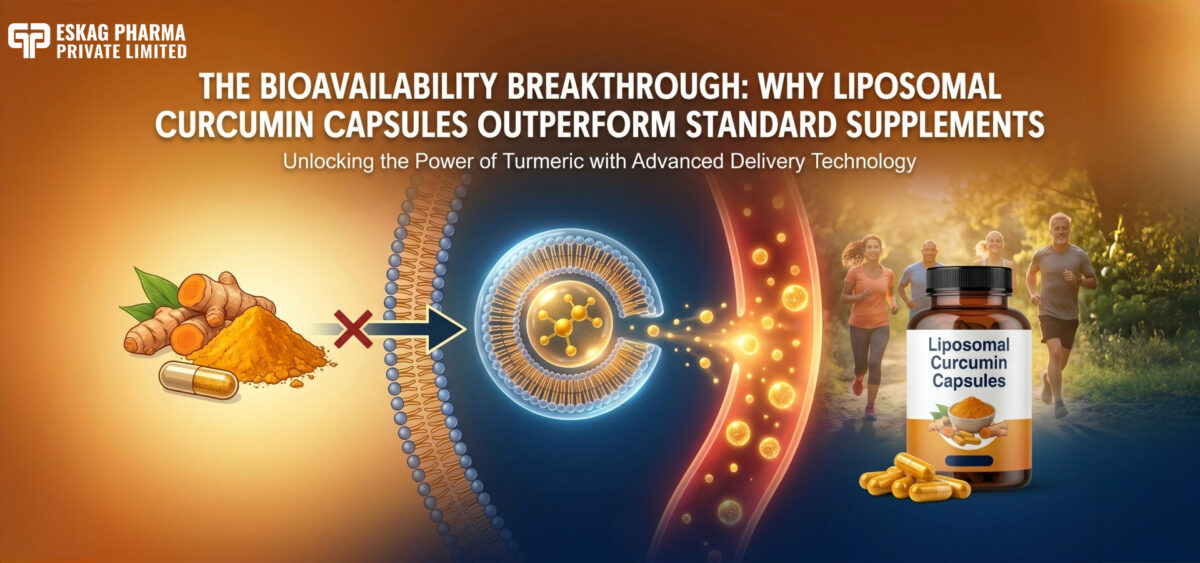
The Bioavailability Breakthrough: Why Liposomal Curcumin Capsules Outperform Standard Supplements
Curcumin, the golden active compound in turmeric, is prized for its powerful anti-inflammatory, antioxidant, and health-supporting properties. Yet for most people taking standard turmeric supplements, these benefits remain largely out of reach. Poor curcumin bioavailability is the main reason. The body absorbs very little of it due to low water solubility, rapid breakdown in the gut, and quick liver metabolism. As a result, most of the curcumin is excreted before it can deliver real therapeutic effects.
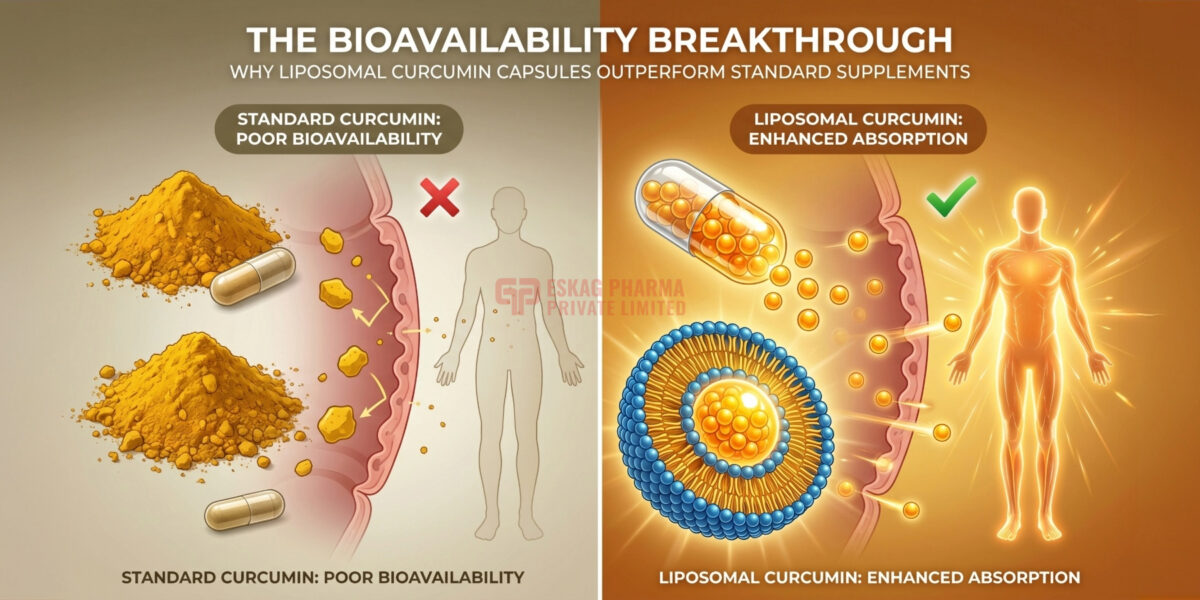
This is where liposomal curcumin capsules make a remarkable difference. Using a liposomal delivery system for curcumin, the active compound is wrapped in tiny phospholipid vesicles that closely resemble human cell membranes. These protective layers shield curcumin from harsh digestive conditions, improve intestinal uptake, and allow far higher amounts to enter the bloodstream.
Clinical studies show liposomal formulations can enhance liposomal curcumin absorption by 10 to 46 times compared to regular curcumin. This means better results at lower doses, improved tolerability, and more consistent benefits for joint comfort, overall wellness, and daily vitality.
In this article, we explore the science behind the absorption barrier, compare liposomal vs regular curcumin, examine manufacturing excellence, and explain why forward-thinking brands choose contract manufacturing for high-quality liposomal curcumin capsules. Discover how this bioavailability breakthrough is changing the future of turmeric supplementation.
Key Takeaways
- The Absorption Barrier: Standard curcumin is notoriously difficult for the body to absorb due to its hydrophobic nature and rapid metabolism. Curcumin Bioavailability is the most significant hurdle in turmeric supplementation, as most of the active compound is excreted before it can provide therapeutic benefits.
- The Liposomal Solution: By utilizing a liposomal delivery system for curcumin, active curcuminoids are encapsulated in phospholipid bilayers. This technology mimics human cell membranes, allowing the nutrients to bypass the harsh digestive environment and enter the bloodstream directly, dramatically increasing the liposomal curcumin absorption rate.
- Strategic Manufacturing Excellence: Scaling an advanced nutraceutical requires specialized infrastructure. Partnering for contract manufacturing for curcumin capsules ensures that your brand utilizes a WHO-GMP certified formulation. Expert liposomal curcumin manufacturing involves high-shear homogenization to ensure consistent vesicle size and long-term stability.
Turmeric has been revered for centuries in Ayurvedic and traditional medicine for its potent anti-inflammatory and antioxidant properties. Yet modern clinical science has revealed a fundamental problem: the active compound responsible for these benefits, curcumin, is remarkably difficult for the human body to absorb. Curcumin bioavailability — the degree to which curcumin can be absorbed and used by the body — has been the central challenge preventing standard turmeric supplements from delivering their full therapeutic promise. This article provides a comprehensive, science-backed exploration of why liposomal curcumin capsules represent the most significant advancement in curcumin supplementation today.
The Absorption Barrier: Understanding the Curcumin Bioavailability Challenge
Before we can appreciate the solution, we must deeply understand the problem. Curcumin bioavailability is not merely a technical concern for scientists — it is the determining factor between a supplement that works and one that is essentially inert.
Why Standard Turmeric Extracts Suffer from Poor Solubility
Curcumin is a hydrophobic polyphenol, meaning it repels water. Since the gastrointestinal tract is an aqueous environment, curcumin molecules do not dissolve or disperse effectively. Instead of being absorbed, they largely pass through the digestive system intact. Studies have confirmed that standard curcumin exhibits extremely low water solubility — approximately 11 nanograms per milliliter — which makes systemic absorption nearly impossible without technological intervention. This is the primary reason curcumin bioavailability from raw turmeric powder or standard extracts is well below 1% in most human models.
The Role of the Liver in Rapid Curcumin Metabolism
Even the small fraction of curcumin that manages to be absorbed through the intestinal wall faces another obstacle: first-pass metabolism. The liver rapidly conjugates curcumin into glucuronide and sulfate forms, which are then excreted via bile. This rapid hepatic metabolism significantly reduces plasma concentration levels, dramatically shortening the window during which curcumin can exert its biological effects. The result is that curcumin bioavailability from standard oral supplementation is compromised at two distinct stages — first at absorption and again at hepatic clearance.
Impact of Low Bioavailability on Clinical Efficacy
The clinical implications of poor curcumin bioavailability are significant. Numerous studies that have shown promising anti-inflammatory, neuroprotective, and anti-cancer properties of curcumin have relied on extremely high doses — sometimes several grams per day — to achieve measurable plasma concentrations. For the average consumer taking standard turmeric capsules, these concentrations are virtually impossible to reach safely. This has led researchers and nutraceutical innovators to explore systematic strategies to enhance curcumin bioavailability, ultimately paving the way for liposomal technology.
How to Increase Curcumin Absorption: The Evolution of Science
Scientists and formulators have long sought answers to how to increase curcumin absorption. The journey from simple spice powder to advanced liposomal formulations reflects decades of biochemical research and innovation.
Traditional Methods: Piperine and Fat-Soluble Pairings
The earliest and most widely known strategy for how to increase curcumin absorption involved combining it with piperine, the active alkaloid in black pepper. Research has shown that piperine can inhibit hepatic and intestinal glucuronidation, slowing the metabolic elimination of curcumin and thereby increasing its bioavailability by up to 2,000% in some studies. While this is a marked improvement, piperine has notable limitations. It can interact with certain medications, irritate the gastrointestinal lining, and may not be appropriate for all populations including children and pregnant women. Similarly, taking curcumin with dietary fats was observed to enhance absorption since curcumin is fat-soluble. However, this approach provides inconsistent results and is difficult to standardize in a supplement format.
Beyond Black Pepper: Modern Curcumin Bioavailability Solutions
As nutraceutical science evolved, researchers developed more sophisticated answers to how to increase curcumin absorption. These included phospholipid complexes (phytosomes) that bind curcumin to phosphatidylcholine for improved membrane permeability, self-emulsifying drug delivery systems (SEDDS) that spontaneously form emulsions in the gastrointestinal tract, and solid lipid nanoparticles (SLNs) that encapsulate curcumin in a lipid matrix. While each of these approaches offered improvements over standard curcumin, none achieved the elegance and efficacy of the liposomal delivery system — the gold standard in modern curcumin bioavailability enhancement.
How to Increase Curcumin Absorption Through Nano-technology
Nanotechnology has introduced a paradigm shift in understanding how to increase curcumin absorption. By reducing curcumin particles to the nanoscale — typically below 200 nanometers — scientists can exponentially increase the surface area available for intestinal absorption. Nanoparticle curcumin formulations leverage polymeric carriers such as PLGA (poly lactic-co-glycolic acid) or lipid-based nanostructures. Among these, liposomes represent the most biocompatible and clinically validated nanotechnology platform, combining the nanoscale size advantage with a phospholipid structure that is inherently compatible with biological membranes.
The Liposomal Delivery System for Curcumin: A Technical Overview
The liposomal delivery system for curcumin is widely regarded as the most advanced and physiologically compatible method of curcumin supplementation available today. To understand why it works so effectively, it is essential to examine its structure and mechanisms at a molecular level.
The Anatomy of a Liposomal Vesicle
A liposome is a spherical vesicle composed of one or more concentric phospholipid bilayers surrounding an aqueous core. The phospholipids used — most commonly phosphatidylcholine derived from sunflower or soy lecithin — arrange themselves in a double layer, with their hydrophilic (water-attracting) heads facing outward and their hydrophobic (fat-attracting) tails facing inward. This structure creates both a water-compatible outer shell and a lipid-rich inner membrane. The liposomal delivery system for curcumin exploits this dual-nature architecture: hydrophilic compounds can be encapsulated in the aqueous core, while hydrophobic compounds like curcumin are embedded within the lipid bilayer itself, shielding them from premature degradation.
How Phospholipids Protect Active Curcuminoids
When curcumin is encapsulated within a liposome, the phospholipid bilayer serves as a protective barrier against the harsh conditions of the gastrointestinal tract. Stomach acid, bile salts, and digestive enzymes that would ordinarily degrade free curcumin molecules are unable to penetrate the intact liposomal membrane. This dramatically increases the amount of curcumin that reaches the small intestine in its biologically active form. Furthermore, the phospholipid shell of the liposomal delivery system for curcumin allows the vesicle to interact directly with the enterocytes (intestinal cells) lining the gut wall, facilitating both endocytotic uptake and direct membrane fusion — two mechanisms that significantly enhance intracellular curcumin delivery.
The Mechanism of Intestinal Uptake via the Liposomal Delivery System for Curcumin
The intestinal absorption of liposomal curcumin differs fundamentally from the passive diffusion that governs conventional supplement absorption. The liposomal delivery system for curcumin primarily utilizes endocytosis — where enterocytes actively engulf the liposomal vesicle — and membrane fusion, where the lipid bilayer of the liposome merges with the cell membrane. Both pathways deliver curcumin directly into the intracellular environment, bypassing the conventional absorption bottlenecks. Additionally, liposomes can be absorbed via the lymphatic system through intestinal M cells in Peyer’s patches, which allows them to partially bypass first-pass hepatic metabolism, keeping more curcumin in its active unconjugated form for longer periods.
Analyzing Liposomal Curcumin Absorption: Data-Driven Results
Clinical and pharmacokinetic data on liposomal curcumin absorption is compelling and growing. The evidence base provides a clear and quantifiable picture of how this delivery format outperforms all competing technologies.
Comparative Blood Plasma Levels: Standard vs. Liposomal
Multiple pharmacokinetic studies have directly compared liposomal curcumin absorption against standard curcumin formulations. Results consistently show that liposomal curcumin produces significantly higher peak plasma concentrations (Cmax) and greater area under the curve (AUC) values — the gold standard metrics for bioavailability assessment. Studies have reported that liposomal curcumin can achieve bioavailability 5 to 10 times greater than standard 95% curcumin extract, and comparable or superior results to piperine-enhanced formulas — without any of piperine’s associated risks. In practical terms, this means a user taking 500 mg of liposomal curcumin may achieve the same or greater plasma levels as someone taking 2,000-5,000 mg of conventional curcumin.
Sustained Release: Prolonging the Presence of Curcumin in the Body
Beyond peak absorption, liposomal curcumin absorption is characterized by a prolonged release profile. The protective phospholipid membrane gradually releases curcumin into the bloodstream over an extended period, resulting in a broader absorption curve rather than a sharp spike followed by rapid elimination. This sustained-release characteristic is particularly important for anti-inflammatory and neuroprotective applications, where maintaining consistent plasma concentrations throughout the day is more therapeutically relevant than brief peak levels. Liposomal curcumin absorption studies consistently show elevated plasma levels at 4, 8, and even 12 hours post-ingestion compared to conventional formulations that are largely cleared within 2-3 hours.
Why High Liposomal Curcumin Absorption Leads to Better Health Outcomes
Improved liposomal curcumin absorption directly translates into measurable health outcomes. Enhanced bioavailability means that curcumin is available to interact with its biological targets — including NF-kB (a key inflammatory signaling molecule), COX-2 (cyclooxygenase-2), and various pro-inflammatory cytokines — at concentrations sufficient to exert meaningful effects. Clinical trials using high-bioavailability curcumin formulations have reported significant improvements in markers of systemic inflammation (CRP, IL-6), joint pain scores in osteoarthritis patients, cognitive function metrics in aging populations, and metabolic markers including blood glucose and lipid profiles. These outcomes, largely absent in trials using standard curcumin, are directly attributable to the superior liposomal curcumin absorption achieved through the liposomal format.
Liposomal vs Regular Curcumin: The Ultimate Comparative Verdict
The debate of liposomal vs regular curcumin is not merely academic — it has direct consequences for brands formulating supplements, healthcare professionals recommending them, and consumers investing in their health.
Efficiency Comparison: Achieving More with Lower Dosages
The most compelling argument in the liposomal vs regular curcumin debate is dosage efficiency. Standard curcumin products typically require doses of 1,000-3,000 mg per day to achieve therapeutic plasma levels — and even then, results are inconsistent. Liposomal curcumin, by contrast, can achieve equivalent or superior plasma concentrations at doses of 200-500 mg per day. This 5-10x dosage efficiency advantage is transformative for product formulation. It allows manufacturers to produce capsules with lower total curcumin content while delivering superior bioavailability, reducing raw material costs, and allowing for more compact capsule sizes that are easier for consumers to swallow and incorporate into daily routines.
Cost-Benefit Analysis of Liposomal vs Regular Curcumin
On the surface, liposomal curcumin products command a higher retail price than standard turmeric supplements. However, a thorough cost-per-effective-dose analysis often reveals a different picture in the liposomal vs regular curcumin comparison. When you account for the fact that a consumer may need 5-10x more standard curcumin to approach the bioavailability of a liposomal product, the price-per-therapeutic-dose often favors liposomal formulations. Additionally, the ability to use lower total curcumin content in liposomal capsules means that manufacturing costs for brands are offset by reduced raw material requirements, making it a commercially viable and scientifically superior choice.
Consumer Preference and Digestive Comfort
Consumer feedback increasingly favors liposomal formats in the liposomal vs regular curcumin comparison, particularly with respect to digestive tolerability. High-dose standard curcumin can cause gastrointestinal discomfort including nausea, bloating, and loose stools — effects that are largely eliminated when lower doses of liposomal curcumin are used to achieve the same therapeutic outcomes. Moreover, liposomal curcumin products that avoid piperine are suitable for a broader population segment, including those on medications sensitive to piperine’s enzyme-inhibitory effects.
The Practical Benefits of Liposomal Curcumin Capsules
Among the various formats for delivering liposomal curcumin — including liquids, gels, and sprays — liposomal curcumin capsules have emerged as the preferred format for both manufacturers and consumers. The reasons are multifaceted and rooted in practicality, stability, and compliance science.
Convenience and Precision of Liposomal Curcumin Capsules
Liposomal curcumin capsules offer unmatched dosing precision. Each capsule contains an exactly calibrated quantity of liposomal curcumin, ensuring that consumers receive a consistent, reproducible dose with every serving. This is critically important for both efficacy and safety. Liquid liposomal products, by contrast, require the user to measure doses by volume — a process prone to error and inconsistency. For consumers managing health conditions where consistent curcumin plasma levels are desired, the precision of liposomal curcumin capsules is a significant practical advantage.
Stability and Shelf-Life Advantages of Dry Liposomal Formats
One of the most significant technical advantages of liposomal curcumin capsules over liquid liposomal formats is stability. Liquid liposomes are inherently susceptible to oxidative degradation, microbial contamination, and hydrolysis of the phospholipid bilayer over time. Dry liposomal formulations, encapsulated in capsules with appropriate excipients, can achieve shelf lives of 24-36 months when stored under appropriate conditions. Advanced drying technologies such as lyophilization (freeze-drying) and spray drying are used during liposomal curcumin manufacturing to produce free-flowing powders that retain vesicle integrity and curcumin potency throughout the product’s commercial life.
Patient Compliance: Why Capsules Outperform Liquid Liposomes
Compliance is a critical determinant of supplement effectiveness in real-world settings. No matter how scientifically superior a formulation may be, it only works if consumers take it consistently. Liposomal curcumin capsules benefit from decades of consumer preference data that consistently shows capsules are among the most accepted oral supplement formats globally. They are portable, easy to take without water in a pinch, taste-neutral (eliminating the bitter, earthy taste that often plagues liquid curcumin products), and familiar. For brands, this translates into better customer retention, more positive reviews, and stronger lifetime value per customer.
The Intricacies of Liposomal Curcumin Manufacturing
The scientific superiority of liposomal curcumin is not automatically conferred by simply mixing curcumin with phospholipids. Authentic, high-efficacy liposomal curcumin manufacturing is a complex, precision-driven process that requires specialized equipment, deep scientific expertise, and rigorous quality control protocols.
High-Shear Homogenization and Particle Size Control
The foundation of effective liposomal curcumin manufacturing lies in achieving consistently small, uniform vesicle sizes. Vesicles that are too large (above 400 nm) are poorly absorbed; those that are too polydisperse (highly variable in size) produce inconsistent bioavailability profiles. Professional liposomal curcumin manufacturing utilizes high-shear homogenization — a process in which a lipid-curcumin dispersion is subjected to intense mechanical shear force, breaking down large liposomal aggregates into uniform nanoscale vesicles. This is typically followed by microfluidization or extrusion through polycarbonate membranes to achieve a narrow particle size distribution, typically between 80-150 nm, which is optimal for intestinal absorption.
Stability Testing for Lipid Bilayer Integrity
A critical challenge in liposomal curcumin manufacturing is ensuring that the liposomal structure remains intact throughout the product’s shelf life. Phospholipid bilayers can degrade through oxidation, hydrolysis, or thermal exposure. Professional manufacturers conduct accelerated stability studies under ICH (International Council for Harmonisation) guidelines, subjecting products to elevated temperature and humidity conditions to predict real-world stability. Key parameters measured include particle size distribution (via Dynamic Light Scattering), zeta potential (which predicts colloidal stability), and curcumin encapsulation efficiency. Any reputable liposomal curcumin manufacturing operation will have documented stability data confirming vesicle integrity and active compound retention across the claimed shelf life.
Quality Standards in Professional Liposomal Curcumin Manufacturing
The quality of liposomal curcumin manufacturing is directly tied to the regulatory standards under which it is conducted. WHO-GMP (World Health Organization Good Manufacturing Practice) certification is the international benchmark for pharmaceutical-grade supplement production. Manufacturers operating under WHO-GMP standards are required to maintain validated production processes, conduct in-process quality controls, perform comprehensive finished product testing (including identity, purity, potency, and microbial safety), and maintain detailed batch records for full traceability. For brands seeking to build consumer trust and meet the import requirements of regulated markets such as the EU, USA, and Australia, partnering with a WHO-GMP certified liposomal curcumin manufacturing facility is non-negotiable.
Scaling with B2B Contract Manufacturing for Curcumin Capsules
For nutraceutical brands, health product companies, and private label operators looking to bring a liposomal curcumin product to market, the path to commercial viability runs through expert contract manufacturing for curcumin capsules. Building proprietary liposomal manufacturing infrastructure is capital-intensive and operationally complex; partnering with an established contract manufacturer is the strategic alternative that offers speed, compliance, and scalability.
Growing Global Demand for High-Bioavailability Supplements
The global nutraceutical market is undergoing a fundamental shift toward efficacy-driven, science-backed products. Consumers who have previously been disappointed by the limited effects of standard turmeric supplements are actively seeking higher-bioavailability alternatives. Market research data consistently shows that products positioning around superior bioavailability, clinical evidence, and advanced delivery technology command premium pricing and stronger brand loyalty. This creates a powerful commercial opportunity for brands that invest in contract manufacturing for curcumin capsules using genuinely superior liposomal technology, particularly in markets such as North America, Europe, Australia, and increasingly Southeast Asia and the Middle East.
The Importance of a WHO-GMP Certified Formulation
When evaluating partners for contract manufacturing for curcumin capsules, WHO-GMP certification is the single most important credential to verify. This certification ensures that every batch of your product is manufactured to the same rigorous pharmaceutical-grade standards, with full documentation of the manufacturing process, raw material sourcing, in-process controls, and finished product testing. For brands seeking to distribute products internationally, WHO-GMP certification from the manufacturing partner is often a mandatory prerequisite for import licensing, retail partnerships with major health chains, and third-party quality verification. It is the foundation upon which consumer trust and regulatory compliance are built.
Why Choose Eskag Pharma for Your Contract Manufacturing for Curcumin Capsules
Eskag Pharma stands at the forefront of specialized contract manufacturing for curcumin capsules, combining pharmaceutical-grade infrastructure with deep nutraceutical expertise. As a WHO-GMP certified manufacturer, Eskag Pharma operates state-of-the-art liposomal curcumin manufacturing facilities equipped with advanced high-shear homogenization, microfluidization, and spray-drying capabilities — the same technologies described throughout this article as essential for producing genuinely efficacious liposomal curcumin.
Eskag Pharma offers end-to-end contract manufacturing for curcumin capsules, from formulation development and clinical-grade stability testing to encapsulation, label printing, and export-ready packaging. Brands partnering with Eskag Pharma benefit from custom formulation services tailored to their target market and product positioning, transparent batch documentation, and scalable production volumes that accommodate both market launch quantities and full commercial scale-up.
Whether you are a nutraceutical startup developing your first high-bioavailability product line or an established brand seeking a reliable, compliant manufacturing partner for liposomal curcumin capsules, Eskag Pharma provides the scientific expertise, regulatory credentials, and manufacturing excellence to bring your vision to life — reliably, compliantly, and at the quality level your brand deserves.
Conclusion
The science is unambiguous: curcumin bioavailability is the defining challenge in turmeric supplementation, and the liposomal delivery system is its most complete solution. From the molecular elegance of phospholipid encapsulation to the measurable pharmacokinetic superiority demonstrated in clinical studies, liposomal curcumin capsules represent a genuine breakthrough — not a marketing claim. For brands, the opportunity to capture a growing premium supplement segment through expert contract manufacturing for curcumin capsules has never been more accessible. And for consumers, the promise of a curcumin supplement that actually works — one whose active compounds reach the bloodstream at therapeutically meaningful concentrations — has finally been fulfilled.

-
 📅 June 30, 2026
Key Takeaways The Bioavailability Challenge: Stand... -
 📅 June 29, 2026
Over the past decade, dermatological science has u... -
 📅 June 27, 2026
The global nutraceutical industry faces a critical... -
 📅 June 27, 2026
Iron deficiency anaemia remains the most prevalent... -
 📅 June 26, 2026
Uneven skin tone, persistent redness, and acne tha... -
 📅 June 26, 2026
If you struggle to switch off after a long day, yo... -
 📅 June 26, 2026
India’s sleep aid market is on course to rea... -
 📅 June 26, 2026
Key Takeaways The First-Pass Barrier: Traditional ... -
 📅 June 24, 2026
Sleep disruption is not simply a lifestyle inconve... -
 📅 June 18, 2026
The sleep supplement industry is undergoing a fund...
Low curcumin bioavailability stems mainly from poor water solubility, limited intestinal absorption, rapid liver metabolism (glucuronidation), and quick elimination. Standard curcumin often shows bioavailability below 1%, with most of the compound excreted before it reaches target tissues.
Pair curcumin with healthy fats such as coconut oil, olive oil, or avocado, as it is fat-soluble. Advanced options like liposomal delivery system for curcumin, nanoparticles, or phospholipid complexes also boost uptake effectively. These methods protect the compound and improve how to increase curcumin absorption without relying on piperine.
Liposomal curcumin capsules encapsulate curcumin in phospholipid bilayers that mimic cell membranes. This shields it from stomach acid and enzymes, enhances intestinal uptake, and delivers higher levels to the bloodstream. Standard pills lack this protection, leading to poor absorption and rapid breakdown.
Studies show liposomal formulations can increase liposomal curcumin absorption by 10- to 45-fold or more compared to regular curcumin, depending on the exact technology. This results in higher and more sustained blood plasma levels at lower doses.
Yes. Liposomal curcumin is generally well-tolerated and considered safe for extended use at recommended doses. It often causes fewer digestive issues than high-dose standard curcumin. Always consult a healthcare professional for personalised advice, especially with existing conditions.
Liposomal vs regular curcumin favours the liposomal form for joint pain. Higher absorption leads to better anti-inflammatory effects, reduced pain, and improved mobility in osteoarthritis studies, often at lower doses with better tolerability.
Key steps include dissolving phospholipids, incorporating curcumin via high-shear homogenization or microfluidization, forming uniform vesicles (100-200 nm), drying into stable powder for capsules, and rigorous stability and quality testing. Professional liposomal curcumin manufacturing ensures consistent particle size and bilayer integrity.
Contract manufacturing for curcumin capsules allows brands to access WHO-GMP certified facilities, advanced liposomal technology, regulatory support, and scalable production without heavy capital investment. It speeds up market entry while maintaining consistent quality.
Yes. Eskag Pharma provides expert contract manufacturing for curcumin capsules and liposomal nutraceuticals at its WHO-GMP facility in Haridwar. The team supports formulation development, stability, and global export-ready production. Contact us to discuss your requirements.
Yes. Liposomal curcumin capsules manufactured under WHO-GMP standards can be exported to the USA and Europe with proper documentation, including Certificates of Free Sale and compliance with local regulations (FDA for USA, EFSA/Food Supplement Directive for EU). Eskag Pharma assists with necessary dossiers for smooth market access.