
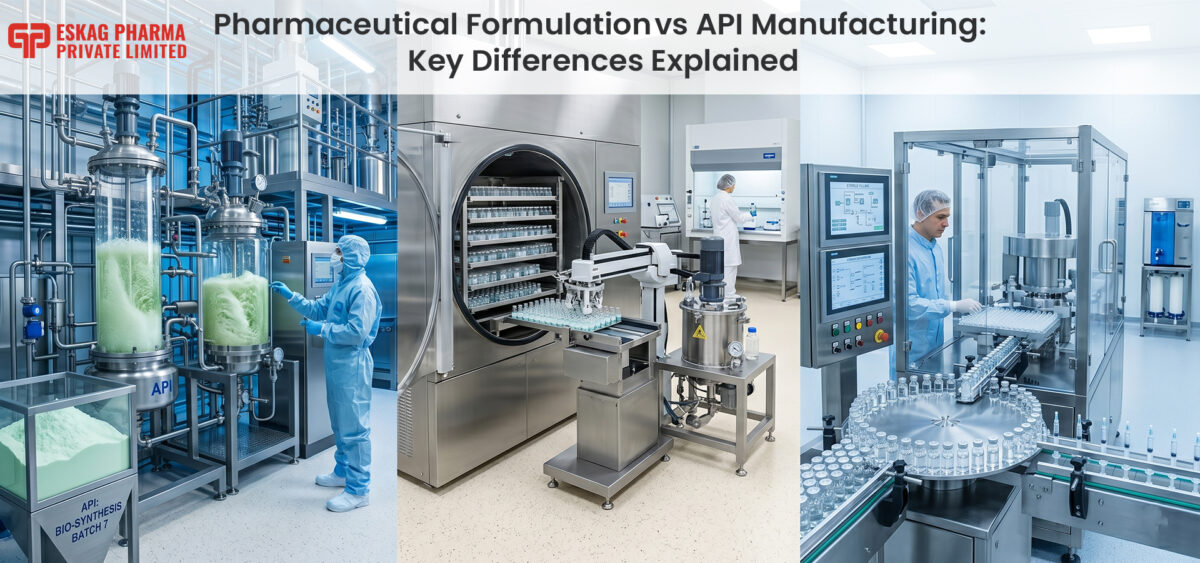
Pharmaceutical Formulation vs API Manufacturing: Key Differences Explained
Key Takeaways
- Distinct Roles: API manufacturing creates the raw active chemical, while formulation pharma turns that chemical into a safe, consumable medicine.
- Complex Development: Rigorous pharmaceutical formulation development is required to ensure the API is effectively absorbed by the patient’s body without degrading.
- Specialized Dosage: Creating a stable pharmaceutical tablet formulation requires different infrastructure and expertise compared to the formulation of pharmaceutical solutions.
- The Right Partner: Outsourcing to a dedicated pharmaceutical formulation manufacturer like Eskag Pharma allows brands to bypass heavy infrastructure costs and focus on market growth.
Understanding the Basics: API vs Formulation Pharma
What is an Active Pharmaceutical Ingredient (API)?
An Active Pharmaceutical Ingredient (API) is the pure chemical or biological substance responsible for the therapeutic effect of a medicine. It is produced in bulk form through complex chemical synthesis, fermentation, or extraction processes. APIs are not intended for direct patient use; they serve as the foundational raw material for all finished dosage forms. Manufacturing APIs demands high-precision chemistry, stringent impurity control, and large-scale chemical reactors.
Defining Formulation Pharma: The Finished Dosage Form
Formulation pharma refers to the critical stage where the API is combined with carefully selected excipients (inactive ingredients) to create a safe, stable, effective, and patient-friendly medicine. This process transforms the raw API powder or liquid into tablets, capsules, syrups, injections, or other dosage forms that can be easily administered and absorbed by the body.
How the Two Manufacturing Stages Create a Complete Medicine
API manufacturing and formulation pharma are two sequential yet entirely different pillars of the pharmaceutical supply chain. While API production focuses on synthesizing the active molecule, formulation pharma ensures the molecule reaches the patient in the right dose, at the right time, with optimal bioavailability and minimal side effects. Together, they deliver a complete, regulatory-approved medicine ready for market.
The Role of a Pharma Formulation Company in Healthcare
Transforming Raw Chemical Bulk into Patient-Ready Medicines
A professional pharma formulation company acts as the bridge between bulk API suppliers and end consumers. It blends the API with binders, fillers, disintegrants, coatings, preservatives, and flavouring agents to develop finished products that are stable, palatable, and compliant with global standards. This transformation requires deep expertise in material science and process engineering.
The Critical Nature of Formulation in Pharmaceutical Industry
Formulation in pharmaceutical industry is far more than simple mixing. It directly influences drug stability, shelf life, dissolution rate, bioavailability, and patient compliance. Poor formulation can render even the most potent API ineffective or unsafe. Hence, every successful medicine depends heavily on advanced formulation in pharmaceutical industry practices.
Balancing Efficacy, Bioavailability, and Patient Compliance
Leading pharma formulation company teams focus on optimizing the balance between therapeutic efficacy, consistent drug release, and ease of use. Factors like taste masking for paediatric or geriatric patients, controlled-release mechanisms, and packaging compatibility play a vital role in modern pharmaceutical formulation development.
The Rigorous Stages of Pharmaceutical Formulation Development
Pre-formulation Studies and Excipient Compatibility
Pharmaceutical formulation development begins with detailed pre-formulation studies. Scientists analyse the API’s physical and chemical properties — solubility, polymorphism, particle size, pH sensitivity, and hygroscopicity. Excipient compatibility studies follow to ensure no unwanted interactions occur between the API and inactive ingredients.
Overcoming Solubility Challenges During Pharmaceutical Formulation Development
Many APIs suffer from poor aqueous solubility, which limits absorption. During pharmaceutical formulation development, techniques such as micronization, solid dispersions, complexation, or lipid-based systems are employed to enhance solubility and bioavailability without compromising stability.
Stability Testing, Clinical Validation, and Scale-Up
Once prototypes are developed, rigorous stability testing under ICH guidelines (accelerated and real-time) is conducted. Pharmaceutical formulation development also includes process validation, clinical batch manufacturing, and technology transfer for commercial scale-up. This ensures every batch maintains consistent quality from pilot to full production.
Exploring Different Types of Dosage Forms
The Engineering Behind a Pharmaceutical Tablet Formulation
Pharmaceutical tablet formulation is one of the most common and complex dosage forms. It involves granulation, compression, coating, and polishing. Parameters like hardness, friability, disintegration time, and dissolution profile must be precisely controlled to ensure uniform drug release and patient safety.
Managing Liquid Stability: Formulation of Pharmaceutical Solutions
The formulation of pharmaceutical solutions (syrups, suspensions, or injectables) presents unique challenges related to solubility, microbial stability, pH, viscosity, and taste. Special attention is given to preservatives, buffering agents, and antioxidants to maintain product integrity throughout shelf life.
Advanced Delivery Systems: Capsules, Liposomes, and Suspensions
Modern pharma formulation company capabilities now include advanced systems such as sustained-release capsules, liposomal delivery, and taste-masked suspensions. These innovations help overcome bioavailability barriers and improve therapeutic outcomes across various therapeutic segments.
Key Differences: Operations, Costs, and Compliance
Chemical Synthesis (API) vs Blending, Coating, and Filling (Formulation)
API manufacturing is chemistry-intensive, involving hazardous reactions, purification, and solvent recovery. In contrast, formulation pharma focuses on blending, granulation, compression, coating, liquid filling, and packaging. The infrastructure, equipment, and environmental controls required for each are vastly different.
Regulatory Pathways: Drug Master Files (DMF) vs Product Dossiers
API manufacturers file Drug Master Files (DMF) detailing synthesis and impurity profiles. Pharmaceutical formulation manufacturers submit product dossiers or CTD files covering formulation composition, manufacturing process, stability data, and bioequivalence studies. Both pathways demand strict regulatory compliance but serve different purposes.
Time-to-Market Differences for API vs Finished Dosage Brands
Developing and scaling an API can take several years due to complex synthesis. Formulation pharma, while also regulated, often allows faster time-to-market for branded or generic finished dosage forms once a reliable API source is secured. This makes outsourcing formulation a strategic advantage for many companies.
Why Choose Eskag Pharma as Your Pharmaceutical Formulation Manufacturer?
A Trusted Pharma Formulation Company with 47+ Years of Legacy
With over 50 years of excellence in pharmaceutical manufacturing, Eskag Pharma has established itself as a trusted pharma formulation company. Our deep domain knowledge and consistent quality have earned the confidence of partners across India and global markets.
WHO-GMP Infrastructure for Every Pharmaceutical Tablet Formulation and Liquid
Our state-of-the-art WHO-GMP certified facility in Haridwar features dedicated lines for pharmaceutical tablet formulation, capsules, oral liquids, and advanced dosage forms. This infrastructure supports high-volume production while maintaining stringent quality and contamination control.
Your Premier Pharmaceutical Formulation Manufacturer for Global Exports
As a leading pharmaceutical formulation manufacturer, Eskag Pharma supports seamless scale-up and regulatory compliance for exports to over 27 countries across Africa, LATAM, Southeast Asia, the Middle East, and beyond. We offer end-to-end solutions — from pharmaceutical formulation development to commercial supply — helping brands launch high-quality products faster and more cost-effectively.
Partner with Eskag Pharma — your reliable pharmaceutical formulation manufacturer and pharma formulation company — to convert quality APIs into market-ready medicines with superior efficacy and patient acceptance.

-
 📅 June 30, 2026
Key Takeaways The Bioavailability Challenge: Stand... -
 📅 June 29, 2026
Over the past decade, dermatological science has u... -
 📅 June 27, 2026
The global nutraceutical industry faces a critical... -
 📅 June 27, 2026
Iron deficiency anaemia remains the most prevalent... -
 📅 June 26, 2026
Uneven skin tone, persistent redness, and acne tha... -
 📅 June 26, 2026
If you struggle to switch off after a long day, yo... -
 📅 June 26, 2026
India’s sleep aid market is on course to rea... -
 📅 June 26, 2026
Key Takeaways The First-Pass Barrier: Traditional ... -
 📅 June 24, 2026
Sleep disruption is not simply a lifestyle inconve... -
 📅 June 18, 2026
The sleep supplement industry is undergoing a fund...
API manufacturing produces the pure active chemical ingredient, whereas formulation pharma combines the API with excipients to create a finished, patient-ready dosage form that is safe, stable, and effective.
A pharma formulation company transforms bulk APIs into finished pharmaceutical products such as tablets, capsules, syrups, and injectables through blending, granulation, coating, filling, and packaging while ensuring quality, stability, and regulatory compliance.
Formulation in pharmaceutical industry directly impacts drug stability, bioavailability, dissolution rate, and shelf life. Proper formulation prevents degradation, ensures consistent dosing, masks unpleasant taste, and reduces side effects, thereby protecting patient safety and improving treatment outcomes.
Key steps in pharmaceutical formulation development include pre-formulation studies, excipient compatibility testing, prototype development, stability studies, process optimization, scale-up, and regulatory validation.
The formulation of pharmaceutical solutions focuses on liquid stability, pH control, microbial preservation, viscosity, and taste masking. Solid dosages like tablets emphasize compression, hardness, disintegration, and coating for controlled release.
A stable pharmaceutical tablet formulation requires proper selection of excipients, controlled moisture and light protection, optimized coating, and rigorous stability testing under ICH guidelines to prevent degradation, maintain potency, and ensure consistent dissolution throughout the shelf life.
Yes. Outsourcing to a dedicated pharmaceutical formulation manufacturer helps brands avoid massive capital investment in dedicated facilities, equipment, and regulatory expertise while benefiting from economies of scale and faster time-to-market.
Most pharma formulation company operations focus only on finished dosage forms. They source APIs from specialized API manufacturers and concentrate expertise on formulation, development, and production of patient-ready medicines.
A reliable pharmaceutical formulation manufacturer should hold WHO-GMP certification along with compliance to relevant national and international regulatory standards to ensure consistent quality and global export acceptability.
Yes. Eskag Pharma offers end-to-end custom pharmaceutical formulation development and third-party manufacturing services for tablets, liquids, capsules, and advanced dosage forms, supported by WHO-GMP certified infrastructure and over 50 years of experience.