
Manufacturing Standards for Women’s Health Supplements: From Formulation to Quality Testing
Women’s health supplements form one of the most clinically sensitive and fastest-growing categories in India’s nutraceutical sector. The manufacturing standards behind these products directly determine whether a woman’s health outcome improves or is put at risk. A poorly chosen iron form, an under-dosed folate, or a probiotic without strain-specific documentation does not just underperform — it fails the person consuming it. For B2B brands entering or expanding in this category, manufacturing quality is not a downstream consideration.
In this blog, you will find a thorough, accurate breakdown of manufacturing standards for women’s health supplements, covering life-stage formulation and ingredient bioavailability, GMP compliance, quality testing, and what to verify before entering into any contract manufacturing partnership for women’s supplements.
Key Takeaways:
- Life-stage formulation is non-negotiable; a multivitamin for women in her reproductive years carries entirely different nutrient priorities than a post-menopausal bone health product.
- The form of the ingredient determines clinical outcome; a calcium supplement for women or an iron supplement must use bioavailable forms, not cost-optimised forms that fail absorption benchmarks.
- GMP certification, FSSAI compliance, third-party testing, and documented stability data are the four non-negotiable verification points before entering any manufacturing partnership for female health supplements.
Quick Answer: Women’s health supplements require life-stage-specific formulations, bioavailable forms of ingredients, FSSAI-compliant GMP manufacturing, and per-batch quality testing, all verified before any contract begins.
Why Women’s Supplements Need Life-Stage Formulations
Women’s health supplements are not a single category; they are a set of clinically distinct formulations tied directly to a woman’s biological stage of life. A product appropriate for a woman in her reproductive years carries entirely different nutrient priorities than one designed for perimenopause or post-menopause.
Here is what life-stage accuracy demands from every formulation decision:
- Menstruating women carry significantly higher iron requirements than men of the same age. A multivitamin for women in this life stage must include iron and folate as primary active ingredients, not as trace additions, to address the gaps most prevalent in Indian women’s daily diets.
- Generic gut probiotics do not address the needs of pregnant women. A randomised controlled trial published in PMC confirmed that oral administration of Lactobacillus rhamnosus GR-1 and Lactobacillus reuteri RC-14 twice daily directly influenced vaginal microbiota composition. Probiotics for women in prenatal formulations must match the strain identity to the documented clinical application.
- Post-menopausal women lose bone mineral density at an accelerated rate after oestrogen decline. A calcium supplement for women in this stage should be co-formulated with Vitamin D3 and K2 to support calcium transport.
- Ingredients such as Ashwagandha and magnesium are common in hormonal formulations. Each must carry a clinically supported dosage specific to the intended indication: PMS relief, cycle regulation, or perimenopausal mood support.
- Iron and calcium deficiencies remain widespread across Indian women of all ages. A credible women’s supplement manufacturer must account for these baseline deficiency patterns when setting nutrient levels, rather than copying Western formulation standards that reflect entirely different dietary baselines.
Ingredient and Bioavailability Standards for Women
A women’s supplement manufacturer that selects ingredients based on cost rather than clinical evidence produces products that pass label testing but fail consumers. Every B2B brand must understand the bioavailability decisions its contract manufacturer makes, because those decisions are invisible on the label but entirely visible in the clinical outcome.
- A meta-analysis confirmed that calcium citrate absorbs 22–27% more effectively than calcium carbonate [1]. Every calcium supplement for women must prioritise ingredient form over batch cost to deliver what the label actually claims.
- A PMC randomised trial confirmed that ferrous bisglycinate has at least 2-fold higher bioavailability than ferrous sulphate, with significantly better tolerability [2]. A critical formulation decision for female supplements targeting iron deficiency in India.
- Standard folic acid requires enzymatic conversion, which a significant proportion of women cannot complete. A credible nutraceutical manufacturer must offer methylfolate in prenatal female health supplements, not as a premium add-on.
- Vitamin D3 without K2 increases calcium absorption but does not direct it to bone tissue. For bone health and women’s health supplements, this pairing is a functional requirement.
- Probiotic Strains Must Match the Indication. Genus-level labelling is insufficient for clinically relevant probiotics targeting urogenital health. Only L. rhamnosus GR-1 and L. reuteri RC-14 carry over 20 years of documented clinical safety data for this specific application.
GMP and Regulatory Compliance in Women’s Supplements
For women’s health supplements, WHO-GMP and FSSAI compliance carry a higher accountability burden than in most supplement categories, because errors in prenatal, hormonal, and bone health formulations can have direct clinical consequences for consumers.
FSSAI Licensing Is Mandatory
Every manufacturer of female health supplements in India must hold a current FSSAI manufacturing licence before a single batch enters production. The licence covers facility inspection, approved ingredient lists, and product registration through the FoSCoS portal. Non-compliance carries enforceable penalties, including mandatory product recalls and business closure.
GMP Covers Nine Operational Areas
Under FSSAI’s GMP framework based on IS 14433:2018, your women’s supplement manufacturer must demonstrate a functioning Quality Management System, trained personnel, validated equipment, approved raw material sourcing, in-process testing, compliant packaging, accurate record-keeping, and documented deviation management procedures across every batch.
Therapeutic Claims Are Prohibited
FSSAI strictly prohibits any claim that a supplement prevents, treats, or cures a human disease. A nutraceutical manufacturer producing hormonal or prenatal female supplements must use FSSAI-permitted structure/function language, for example, “supports hormonal balance”.
Botanical Ingredients Require Specific Approval
India does not automatically recognise EFSA or FDA approvals for botanical ingredients. Regulation 16 of the Nutraceutical Regulations, 2022 requires all botanical ingredients, including Ashwagandha and Shatavari, to be sourced from the Indian Pharmacopoeia or other recognised compendia before inclusion in any female health supplement formulation.
Hormonal Supplements Face Dual Regulatory Scrutiny
In 2024, a government task force recommended that high-potency hormonal support blends and joint health supplements be reviewed under CDSCO guidelines alongside FSSAI requirements. B2B brands sourcing contract manufacturing for hormonal or perimenopausal female supplements must confirm with their manufacturer which regulatory pathway applies to their specific formulation before market entry.
Suggested read: Cost Structure & Pricing Factors in Third-Party Pharmaceutical Manufacturing
Quality Testing Every Women’s Supplement Brand Needs
Women’s health supplements carry a higher testing burden than general supplements because errors in prenatal, hormonal, and bone health formulations reach vulnerable consumer groups.
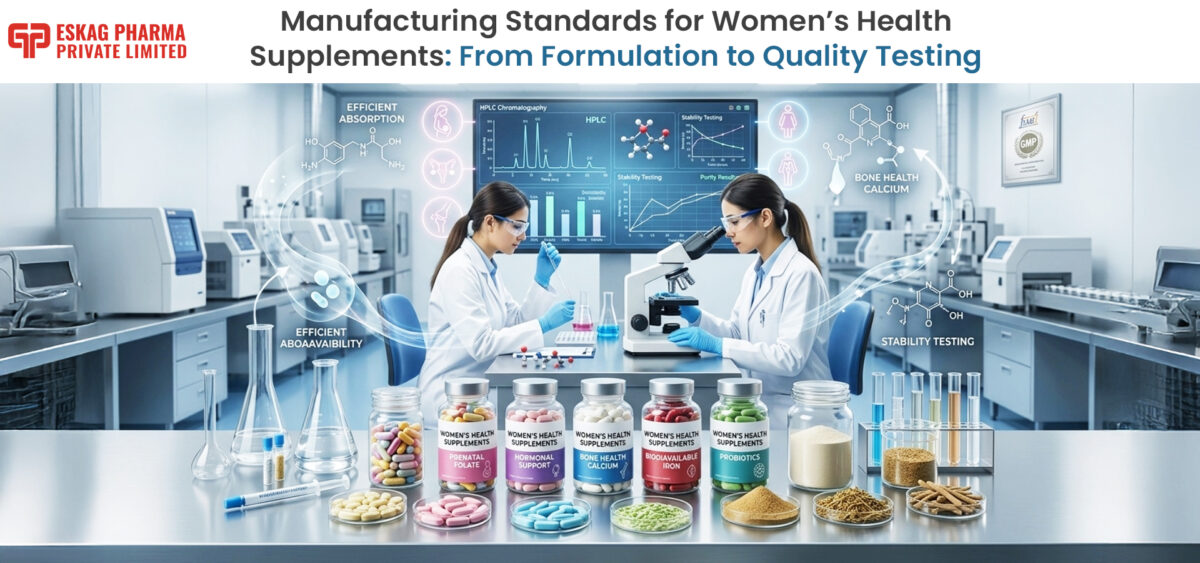
- Every active ingredient in female health supplements — iron, calcium, folate, and vitamin D — must be verified against label claims using HPLC or ICP-MS methods for each batch. Your nutraceutical manufacturer must provide a Certificate of Analysis confirming concentration, not just ingredient inclusion, before any batch receives release approval.
- Herbal blends pose a higher risk of heavy metal contamination than synthetic nutrients. ICP-MS testing for lead, arsenic, cadmium, and mercury must run on every raw material intake and every finished batch, with results documented against FSSAI and export market limits.
- Prenatal and probiotic formulations for women require pathogen screening beyond standard supplement protocols. Your manufacturer must test for E. coli, Salmonella, total aerobic plate count, and yeast and mould counts, particularly for sachet and powder formats where moisture ingress risk is higher during production.
- Folate and vitamin B12 are the most stability-sensitive nutrients in combination multivitamin products for women. Real-time stability testing must be run for each active nutrient to confirm that each ingredient retains potency at the declared level throughout the full shelf life under Indian storage conditions.
- A calcium supplement for women that does not disintegrate correctly within the gastrointestinal tract delivers zero clinical benefit regardless of label potency.
Choosing the Right Women’s Supplement Manufacturer
Choosing a manufacturing partner for women’s health supplements is one of the highest-stakes B2B decisions a brand makes. The clinical sensitivity of this category means that a weak partner not only affects product quality control but also the consumer’s health.
- A credible women’s supplement manufacturer must show documented formulation history across prenatal, hormonal, bone health, and probiotic categories. General nutraceutical capability does not qualify a manufacturer for this category.
- Before entering into any contract manufacturing of women’s supplements, request a Certificate of Analysis for each batch, real-time stability data for each active nutrient, allergen control records, botanical ingredient sourcing documentation, and the manufacturer’s current FSSAI licence. Missing any single document is a valid reason to pause the sourcing decision.
- WHO-GMP, FSSAI, ISO 22000, and HACCP certifications must be current and third-party verified. For Indian brands targeting export markets, confirm that your nutraceutical manufacturer can provide CTD or aCTD dossiers with Certificates of Pharmaceutical Products, which are mandatory for regulatory clearance across Africa, Southeast Asia, and the Middle East.
- A woman’s supplement manufacturer that maintains GMP compliance at small batch sizes but relaxes controls at scale creates a consistency problem your brand will absorb. Ask specifically how environmental monitoring, in-process testing, and batch documentation protocols are maintained when production volumes increase.
- Contract manufacturing of women’s supplements for hormonal, prenatal, or perimenopausal categories requires a manufacturer with in-house formulation expertise. Confirm whether the manufacturer can advise on ingredient form selection, dosage validation, and claim substantiation, or whether they simply execute a brief you provide.
Also read: What Defines a Reliable Pharmaceutical Formulation Company in India?
Why Choose Eskag Pharma
Eskag Pharma’s WHO-GMP and FSSAI-certified facility in SIDCUL, Haridwar, has operated across pharmaceutical and nutraceutical categories for over five decades — giving B2B brands entering contract manufacturing of women’s supplements a manufacturing partner with the regulatory depth, formulation range, and export infrastructure that this category demands.
- Eskag Pharma holds third-party manufacturing and audited WHO-GMP, HACCP, and ISO 9001 certifications. For brands supplying female health supplements to Africa, Southeast Asia, the Middle East, and Latin America, CTD and aCTD dossiers with Certificates of Pharmaceutical Products are available, removing a significant regulatory barrier at market entry.
- Eskag produces across GI, hormonal, gynaecological, and nutraceutical therapeutic categories, including probiotics for women, multivitamin formulations for women, prenatal ranges, and calcium supplements for women, in tablet, hard gel capsule, powder, and sachet formats, within dedicated production units.
- With over 500 approved formulations across pharmaceutical and nutraceutical categories, Eskag offers the production depth a single-category manufacturer cannot match. Your women’s health supplements line operates within a fully integrated, GMP-controlled environment backed by over five decades of documented manufacturing experience.
Final Thoughts
The manufacturing standards behind women’s health supplements are not technical details reserved for scientists; they are the direct determinants of whether your product delivers what it promises to every woman who takes it. Before you sign any manufacturing agreement, verify your partner’s FSSAI licence, request real-time stability data per active nutrient, confirm botanical ingredient approvals under Regulation 16 of the Nutraceutical Regulations 2022, and ask specifically about their experience with prenatal, hormonal, and bone health female health supplements. If your brand targets the Indian domestic market or export markets across Africa, Southeast Asia, or the Middle East, your manufacturing partner must hold WHO-GMP certification, current FSSAI licensing, and the technical capability to advise on ingredient selection.
Eskag Pharma’s five-decade track record in pharmaceutical and nutraceutical manufacturing, combined with its WHO-GMP and FSSAI-certified facility in Haridwar, makes it a credible, documented starting point for brands serious about contract manufacturing of women’s supplements at the highest quality standard.

References
- Sakhaee, K., Bhuket, T., Adams-Huet, B. and Rao, D.S. (1999). Meta-analysis of Calcium Bioavailability. A comparison of calcium citrate with calcium carbonate. American Journal of Therapeutics, 6(6), pp.313–322.
- Bumrungpert A, Pavadhgul P, Piromsawasdi T, Mozafari MR. Efficacy and Safety of Ferrous Bisglycinate and Folinic Acid in the Control of Iron Deficiency in Pregnant Women: A Randomized, Controlled Trial. Nutrients. 2022 Jan 20;14(3):452. doi: 10.3390/nu14030452. PMID: 35276810; PMCID: PMC8839493.
-
 📅 June 30, 2026
Key Takeaways The Bioavailability Challenge: Stand... -
 📅 June 29, 2026
Over the past decade, dermatological science has u... -
 📅 June 27, 2026
The global nutraceutical industry faces a critical... -
 📅 June 27, 2026
Iron deficiency anaemia remains the most prevalent... -
 📅 June 26, 2026
Uneven skin tone, persistent redness, and acne tha... -
 📅 June 26, 2026
If you struggle to switch off after a long day, yo... -
 📅 June 26, 2026
India’s sleep aid market is on course to rea... -
 📅 June 26, 2026
Key Takeaways The First-Pass Barrier: Traditional ... -
 📅 June 24, 2026
Sleep disruption is not simply a lifestyle inconve... -
 📅 June 18, 2026
The sleep supplement industry is undergoing a fund...
What makes women’s health supplements different from general supplements in manufacturing?
A PMC randomised controlled trial confirmed ferrous bisglycinate carries at least two-fold higher bioavailability than ferrous sulphate. Female supplements using lower-cost ferrous sulphate produce higher GI side effects, reducing consumer compliance and negating the supplement’s intended clinical outcome.
A credible women’s supplement manufacturer in India must hold a current FSSAI manufacturing licence, WHO-GMP certification, and ISO 22000 as a minimum. For export markets, CTD and aCTD dossiers, including Certificates of Pharmaceutical Products, are additionally required for regulatory clearance.
A meta-analysis from UT Southwestern confirmed calcium citrate absorbs 22–27% more effectively than calcium carbonate. For any calcium supplement for women targeting post-menopausal bone health, form selection is a clinical decision — not a cost decision.
Before signing any agreement for contract manufacturing of women’s supplements, request the current FSSAI licence, Certificate of Analysis per batch, real-time stability data per active nutrient, botanical ingredient sourcing documentation, and the manufacturer’s third-party GMP audit report.
Probiotics for women targeting vaginal and urinary health require strain-specific selection, specifically L. rhamnosus GR-1 and L. reuteri RC-14, which carry over 20 years of clinical documentation. General gut probiotic strains do not provide these specific urogenital benefits.
Female health supplements in India must carry the FSSAI licence number, batch number, expiry date, ingredient quantities, and allergen information on every label.
Folate and vitamin B12, both critical in multivitamins for women’s formulations, degrade at different rates under storage conditions. Testing the formula as a whole can mask individual nutrient loss. Per-nutrient real-time stability data is the only method that confirms each active retains label potency at expiry.
Regulation 16 of the Nutraceutical Regulations 2022 requires all botanicals in women’s health supplements to be sourced from the Indian Pharmacopoeia or recognised compendia. Using unapproved botanical ingredients renders the product non-compliant, exposes it to FSSAI enforcement action, and may trigger a mandatory product recall.
A nutraceutical manufacturer with verified export capability holds WHO-GMP certification, provides CTD dossiers with CoPPs, and offers multilingual packaging. For female health supplements brands targeting Africa, South East Asia, or the Middle East, this documentation infrastructure directly determines the speed and success of regulatory market entry.