
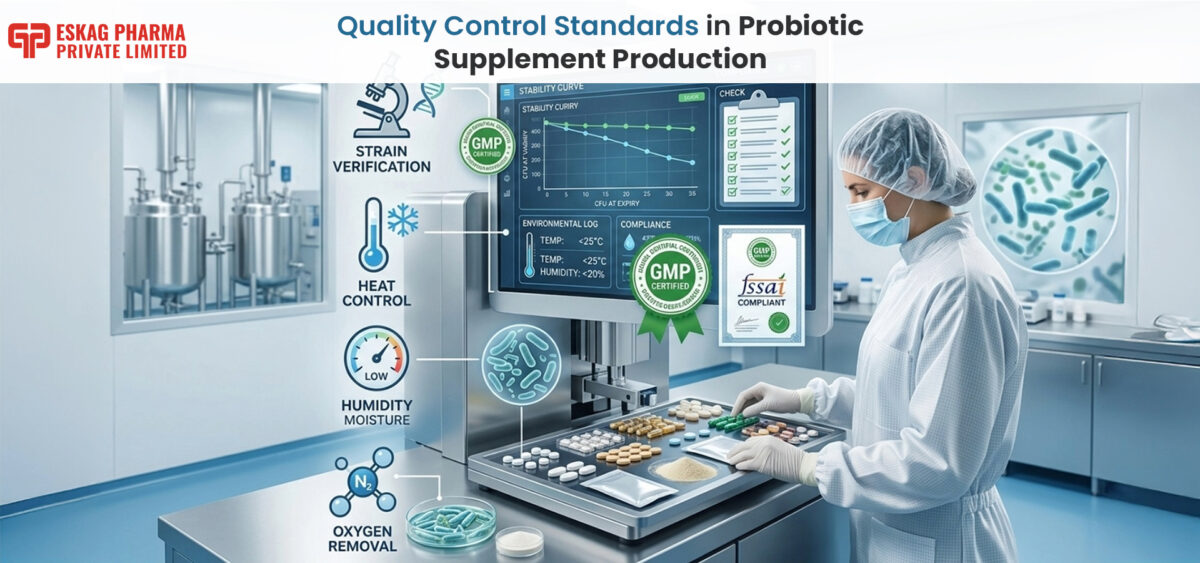
Quality Control Standards in Probiotic Supplement Production
Every supplement brand that sells a probiotic product carries a responsibility that goes well beyond label design or marketing copy. Unlike vitamins or minerals, probiotics are live bacterial cultures, and they die at every stage of production unless the manufacturer controls temperature, humidity, and oxygen without exception. Choosing the wrong probiotic manufacturer does not just affect product quality; it directly affects the health outcomes of every person who consumes your product. India’s nutraceutical sector is growing at a double-digit rate each year, which means more brands are entering this category without fully understanding what separates a credible manufacturing partner from an inadequate one.
In this blog, you will find a thorough breakdown of quality control standards in probiotic supplement production, from fermentation and in-process checks to stability testing, regulatory compliance, and packaging requirements.
Key Takeaways:
- A GMP-certified probiotic manufacturer must control moisture, heat, and oxygen at every production stage to protect bacterial viability.
- CFU counts on probiotic labels must reflect viable organisms at expiry, not at the time of manufacture.
- FSSAI compliance, WHO-GMP certification, and third-party testing are non-negotiable verification points for any B2B sourcing decision in India.
Quick Answer: Probiotic supplements need live bacteria protected throughout every production stage, GMP certification, real-time stability testing, and FSSAI compliance; these are non-negotiable.
Why Probiotics Need Stricter Manufacturing Controls
A qualified probiotic manufacturer operates under fundamentally different production constraints because the product itself is alive.
Most dietary supplements contain inert compounds. Probiotics contain live bacterial cultures. That single distinction changes everything about how you source, process, store, and test these products. One error in temperature, humidity, or handling kills millions of viable organisms before the product reaches the consumer.
Here is what strict quality control must address:
Strain Identity Matters: The International Scientific Association for Probiotics and Prebiotics confirms that probiotic benefits are strain-specific and cannot be generalised across related organisms. Your probiotic supplement manufacturer must use the exact documented strain, genus, species, and strain ID that corresponds to the intended health application.
CFU Levels Count: Colony-forming units measure live, active organisms per dose. Clinical research sets the effective dosage for each specific strain. Your manufacturer must match that exact CFU level, not a lower figure chosen for cost reasons.
Three Threats Exist: Moisture, heat, and oxygen are the three primary causes of bacterial death during production. Qualified facilities maintain humidity below 20%, operate climate-controlled production rooms, and apply nitrogen flushing at the packaging stage to remove residual oxygen before sealing.
Testing Has Rules: Accelerated stability testing, which uses elevated heat and humidity to simulate ageing, compromises live cultures and produces unreliable shelf-life data. Probiotic stability testing must run in real time, under standard storage conditions, across 6 to 24 months, to give you accurate CFU viability data at the point of expiry.
Infrastructure Decides Quality: Probiotic production demands dedicated cleanrooms, HEPA filtration systems, positive air pressure, and continuous environmental monitoring. Facilities without these systems cannot protect strain viability from fermentation through to final dispatch, regardless of what their certificates state.
In-Process Quality Checks from Fermentation to Drying
Every GMP-certified probiotic manufacturer runs quality checks at each production stage, because live bacteria can die at any point between the bioreactor and the sealed sachet or capsule.
Strain Authentication
Before fermentation starts, your manufacturer must confirm the exact identity of the bacterial strain. Strain documentation must include genus, species, and a unique strain ID that corresponds directly to the deposited culture. A peer-reviewed study published in Frontiers in Microbiology (2021) confirmed that viable microorganism counts must reach at least 10⁶ CFU/ml in the small bowel to produce a clinical effect, and that threshold depends entirely on starting with the correct, authenticated strain [1].
Fermentation Parameter Control
During fermentation, temperature and pH must stay within precise, strain-specific ranges at all times. Research shows that human-derived probiotic strains typically require a fermentation temperature of 37°C and automated pH control systems to counteract acid accumulation from bacterial metabolic activity. A study on Lactobacillus rhamnosus GG confirmed that fermentation at pH 6.5 and 37°C produced superior bacterial surface properties and higher adhesion capacity compared to all other tested conditions [2]. A qualified probiotic supplement manufacturer uses automated titration systems, not manual monitoring, to hold these parameters within acceptable limits across every batch.
Centrifugation and Harvest Checks
Once fermentation peaks, typically between 12 and 24 hours, bacteria are harvested via continuous centrifugation. This step separates live bacterial cells from the growth medium without damaging cell walls. Any mechanical stress at this point directly reduces the final CFU count. A buffer wash follows centrifugation to remove residual metabolic waste from the concentrate. Your third-party probiotic manufacturing partner must provide a post-harvest viability report at this stage, documenting the viable count per gram before the material enters the drying stage.
Post-Drying Quality Verification
After lyophilisation, the dried powder must undergo a series of in-process quality checks before it is moved to blending or encapsulation. These checks cover water activity (aw), microbial contaminant screening, and a post-milling viability report that confirms bacteria survived the mechanical stress of powder processing. Research published in PMC on probiotic shelf-life assessment confirmed that water activity must remain below 0.25, even under tropical storage conditions of 30°C and 75% relative humidity, to maintain CFU counts above the minimum effective threshold [3].
Lyophilisation Viability Control
Freeze-drying, or lyophilisation, is the most critical and technically demanding step in probiotic production. Research published in PMC (2024) found that freeze-drying without cryoprotectants can reduce bacterial survival rates to as low as 2% under suboptimal conditions, a catastrophic loss of CFUs before the product even enters packaging [4]. The same study confirmed that liquid nitrogen freezing at −196°C achieved a survival rate of 90.94%, demonstrating how pre-freezing conditions determine the viability of the final powder. A credible probiotic supplement manufacturer uses validated cryoprotectant formulations, typically trehalose, skim milk, or maltodextrin, and documents the lyophilisation cycle parameters for every single batch.
Also read: What is Third-Party Manufacturing & Its Benefits in Pharma?
Knowing what happens inside the bioreactor means little if your product loses viability long before it reaches the consumer.
Stability Testing Standards Every B2B Brand Must Know
The Council for Responsible Nutrition (CRN) and the International Probiotics Association (IPA) jointly published best-practice guidelines that set the industry benchmark for how a qualified probiotic supplement manufacturer must run and document its stability programmes.
- CFU at Expiry: Your label must declare CFU count at the end of shelf life — not at the time of manufacture. A product that shows 10 billion CFU at production but 2 billion at expiry misleads every buyer in your supply chain.
- Real-Time Is Non-Negotiable: The CRN-IPA guidelines state that stability testing must be conducted under real-time conditions that match the storage temperature listed on your finished product label. Accelerated testing requires separate scientific justification; it cannot substitute real-time data.
- ICH Storage Conditions Apply: Long-term real-time studies must follow ICH Q1A(R2) parameters: 25°C ±2°C at 60% relative humidity for room-temperature products, or 5°C ±3°C for refrigerated formats. For Indian market conditions, your GMP-certified probiotic manufacturer must factor in tropical storage realities within these frameworks.
- 100% Label Compliance Required: Products must contain 100% of the declared CFU quantity at the end of shelf life. The only permitted variance is that attributable to the test method itself, not to poor formulation or inadequate packaging.
- Documentation Is Mandatory: Every stability test method, including proprietary methods, must be scientifically sound, repeatable, reproducible, and fully documented. You must request this paperwork from your manufacturer before you sign any contract.
Sound production controls only retain value when the certifications that support them are independently verified.
GMP, FSSAI, and Third-Party Testing: What to Verify
When you choose a probiotic manufacturer in India, their certifications are not wall decorations; they are legally enforceable quality commitments that directly determine whether your product can be sold, exported, or recalled.
A peer-reviewed study published in the World Journal of Advanced Research and Reviews (2024) confirmed that India’s FSSAI framework under the Food Safety and Standards Act, 2006, is significantly more stringent than comparable Asian regulatory systems, which means your manufacturing partner carries a higher compliance burden, and you need to verify they meet it.
- Every GMP-certified probiotic manufacturer in India must hold a current FSSAI manufacturing licence before a single batch enters production. This licence covers facility inspections, approved ingredient lists, and product registration.
- Under FSSAI’s GMP framework, your manufacturer must demonstrate a functioning Quality Management System, trained personnel, clean and validated facilities, approved sourcing of raw materials, in-process testing, compliant packaging, accurate record-keeping, and a documented deviation management process.
- A Certificate of Analysis from an accredited, independent laboratory must accompany every batch. For third-party manufacturing in India, this document must confirm identity, purity, CFU count, and absence of specified contaminants before product release.
- FSSAI labelling rules require your product to display the manufacturer’s FSSAI licence number, batch number, expiry date, ingredient quantities, and full manufacturer contact details. Missing any one field makes the product non-compliant.
- FSSAI enforces mandatory product recalls, financial penalties, and, in serious cases, business closure for manufacturers who fail compliance audits. Before you sign any contract, request your partner’s most recent internal audit report and third-party GMP certification from a recognised body such as NSF International.
Packaging Quality Standards in Probiotic Production
Packaging is not the last step in probiotic production; it is an active quality-control decision that either protects or destroys everything your probiotic manufacturer built upstream during fermentation and drying.
Oxygen Barrier Selection
Research published in PMC confirms that Bifid bacteria, among the most commercially used probiotic strains, are strict anaerobes and are highly susceptible to oxygen exposure through packaging materials. A GMP-certified probiotic manufacturer must select packaging with an oxygen transmission rate matched to the specific strain’s sensitivity. Nitrogen flushing during the seal process removes residual oxygen before the container closes.
Moisture Control in Sachet Formats
A probiotic sachet contract manufacturer assumes heightened responsibility for moisture control. Sachets have a large surface area relative to their volume, which increases the risk of moisture ingress during both production and storage. Foil-laminate constructions with polyethene and aluminium layers provide the strongest moisture vapour transmission barrier available for sachet formats. Desiccant layers within the sachet structure add a secondary line of defence against humidity.
Storage Condition Alignment
Packaging choices must reflect every environment the product passes through, not just the end consumer’s shelf. The CHPA best practices guidelines state that manufacturers must account for warehouse conditions, transit temperatures, retail storage, and in-home use when specifying packaging materials. Third-party probiotic manufacturing partners must provide documented storage condition data for each formulation, format, and target market climate zone before product release.
HDPE Bottles for Capsule and Tablet Formats
For capsule and tablet formats, high-density polyethene (HDPE) bottles remain the standard primary packaging choice due to their proven water-barrier performance. CSP bottles offer additional oxygen barrier performance for strains with higher sensitivity to atmospheric exposure during long shelf-life programmes.
Packaging as Part of Probiotic Stability Testing
The packaging format must be included in the probiotic stability testing programme — not treated as a separate variable. The CRN-IPA guidelines require that stability studies be run on the finished product in the final packaging proposed for market, not on bulk powder or intermediate formats. Any change in packaging material after stability data is generated requires a new stability assessment to confirm that the CFU guarantee at expiry remains valid.
Why Choose Eskag Pharma for Probiotic Supplements
Eskag Pharma has operated as a trusted probiotic manufacturer from its WHO-GMP and FSSAI-certified facility in SIDCUL, Haridwar, Uttarakhand, for over five decades, combining pharmaceutical-grade quality standards with the specific technical demands of live microorganism production.
- Eskag Pharma’s Haridwar manufacturing unit holds WHO-GMP, HACCP, and ISO 9001 certifications.
- Eskag produces probiotics and prebiotics in tablet, hard gel capsule, powder, and sachet formats within dedicated GI and nutraceutical divisions. CTD and aCTD regulatory dossiers, including Certificates of Pharmaceutical Products (CoPPs), are available.
- With over 500 approved formulations across pharmaceutical and nutraceutical categories, Eskag offers the production depth and regulatory experience that a single-category manufacturer cannot match.
- Eskag Pharma supplies domestic and international markets and has a global presence across Africa, Latin America, South East Asia, the Middle East, and CIS countries. The company participates actively in CPHI Frankfurt, Vitafoods Europe, Vitafoods India, and iPHEX.
Final Thoughts
Quality control in probiotic production is not a checkbox; it is the cumulative result of every verified decision made between strain authentication and final dispatch. If you source from a manufacturer without real-time stability data, documented in-process checks, and verified certifications, your brand carries that risk directly to the consumer. Before you finalise any manufacturing partnership, request the Certificate of Analysis, post-milling viability report, real-time stability records, and third-party GMP audit documentation without exception.
Eskag Pharma operates from a WHO-GMP and FSSAI-certified facility in Haridwar, with over five decades of pharmaceutical manufacturing experience and verified export reach across Africa, South East Asia, the Middle East, and Latin America.

References
- Wendel, U. (2022). Assessing Viability and Stress Tolerance of Probiotics—A Review. Frontiers in Microbiology, 12.
- Deepika G, Karunakaran E, Hurley CR, Biggs CA, Charalampopoulos D. Influence of fermentation conditions on the surface properties and adhesion of Lactobacillus rhamnosus GG. Microb Cell Fact. 2012 Aug 29;11:116. doi: 10.1186/1475-2859-11-116. PMID: 22931558; PMCID: PMC3441878.
- Visciglia A, Allesina S, Amoruso A, De Prisco A, Dhir R, Bron PA, Pane M. Assessment of shelf-life and metabolic viability of a multi-strain synbiotic using standard and innovative enumeration technologies. Front Microbiol. 2022 Nov 4;13:989563. doi: 10.3389/fmicb.2022.989563. PMID: 36406457; PMCID: PMC9672074.
- Wang J, Wu P, Dhital S, Yu A, Chen XD. Impact of Freezing and Freeze Drying on Lactobacillus rhamnosus GG Survival: Mechanisms of Cell Damage and the Role of Pre-Freezing Conditions and Cryoprotectants. Foods. 2025 May 20;14(10):1817. doi: 10.3390/foods14101817. PMID: 40428596; PMCID: PMC12111118.
-
 📅 June 30, 2026
Key Takeaways The Bioavailability Challenge: Stand... -
 📅 June 29, 2026
Over the past decade, dermatological science has u... -
 📅 June 27, 2026
The global nutraceutical industry faces a critical... -
 📅 June 27, 2026
Iron deficiency anaemia remains the most prevalent... -
 📅 June 26, 2026
Uneven skin tone, persistent redness, and acne tha... -
 📅 June 26, 2026
If you struggle to switch off after a long day, yo... -
 📅 June 26, 2026
India’s sleep aid market is on course to rea... -
 📅 June 26, 2026
Key Takeaways The First-Pass Barrier: Traditional ... -
 📅 June 24, 2026
Sleep disruption is not simply a lifestyle inconve... -
 📅 June 18, 2026
The sleep supplement industry is undergoing a fund...
A GMP-certified probiotic manufacturer guarantees consistent production standards covering personnel, equipment, raw materials, and batch documentation. Certification confirms third-party verification of these controls.
Probiotic bacteria die gradually during storage, so a CFU count at manufacture overstates what the consumer actually receives. The CRN-IPA guidelines require that labels reflect viable counts at the end of the stated shelf life.
Research published in Frontiers in Microbiology confirms that viable counts must reach at least 10⁶ CFU/ml in the small bowel to produce a clinical effect. Your manufacturer must set overage levels at production to protect this threshold through to expiry.
Elevated heat and humidity conditions used in accelerated testing directly compromise live bacterial cultures, producing unreliable shelf-life data. Real-time testing under standard storage conditions remains the only scientifically valid method for probiotic products.
Your manufacturer must supply a current FSSAI manufacturing licence, a Certificate of Analysis from an accredited laboratory, and full batch documentation for each production run. Labels must carry the FSSAI licence number, batch number, and expiry date without exception.
Research confirms that packaging with high oxygen permeability reduces viable counts of anaerobic strains, such as Bifidobacteria, throughout the storage period. Foil-laminate sachets with aluminium layers and nitrogen flushing provide the strongest barrier against both moisture and oxygen ingress.
Third-party probiotic manufacturing requires specialist infrastructure, climate-controlled cleanrooms, HEPA filtration, and lyophilisation equipment, which standard contract facilities do not maintain. Brands must verify these specific capabilities before placing any production order with a manufacturer.
You must request the post-harvest viability report, post-milling viability report, real-time stability data, Certificate of Analysis, and the manufacturer’s GMP certification from a recognised third-party body. Missing any one of these documents is a legitimate reason to pause a sourcing decision.
Research data shows CFU counts drop below the minimum effective threshold at 30°C storage after just 12 months without proper packaging and overage strategies. Indian brands must confirm that their manufacturer’s stability programme uses storage conditions that reflect actual domestic distribution temperatures.
A probiotic sachet contract manufacturer targeting export must hold WHO-GMP certification, a valid FSSAI licence, and CTD or aCTD dossiers with Certificates of Pharmaceutical Products. These documents are mandatory for regulatory clearance in Africa, Southeast Asia, the Middle East, and CIS markets.