
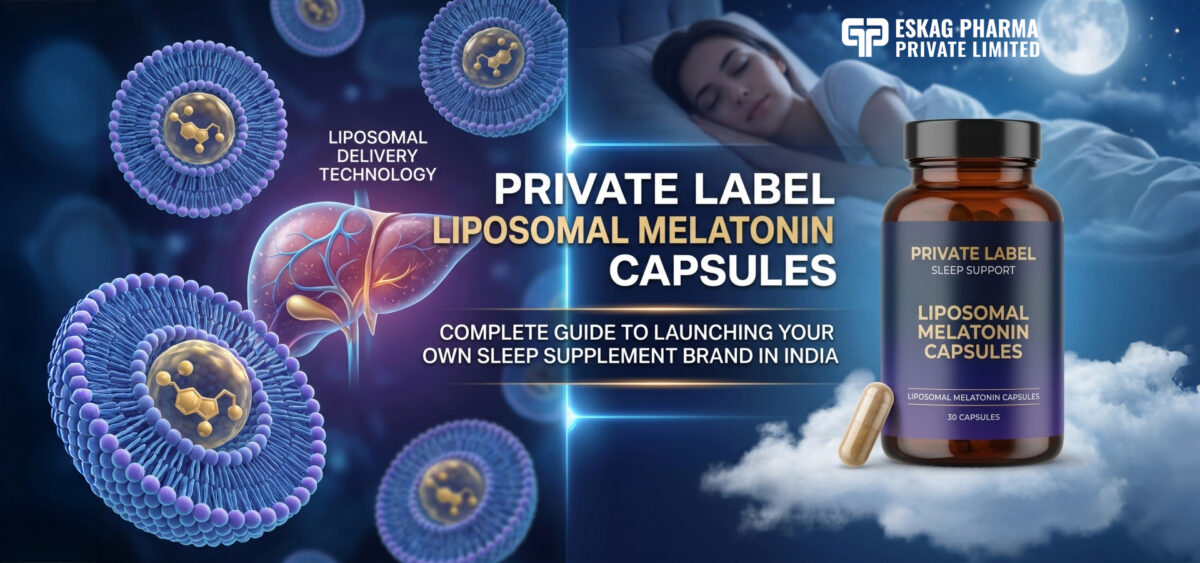
Private Label Liposomal Melatonin Capsules: Complete Guide to Launching Your Own Sleep Supplement Brand in India
India’s sleep aid market is on course to reach USD 699.47 million by 2033, yet standard melatonin tablets deliver well below their stated dose; hepatic first-pass metabolism destroys 50-70% of each dose before it enters the bloodstream. Three out of five Indians sleep fewer than six hours per night, and most have not found a supplement that works reliably. Private label liposomal melatonin capsules address this at the formulation level by increasing active melatonin bioavailability to 80-95% through phospholipid encapsulation.
This guide covers the science, FSSAI compliance, and manufacturing decisions you need to bring one to market in India.
Key Takeaways
- The Superior Sleep Solution: Standard melatonin is notoriously vulnerable to stomach acid and first-pass metabolism in the liver. Encapsulating the hormone in a phospholipid bilayer creates highly bioavailable, private label liposomal melatonin Capsules, allowing the active ingredient to bypass digestive destruction and be absorbed directly into the bloodstream for faster, more restorative sleep without the morning hangover.
- Rapid Market Entry: Building a successful sleep supplement brand from scratch requires massive capital for R&D and cleanroom infrastructure. By utilising a pre-formulated, stability-tested white-label liposomal melatonin capsule, brands can drastically reduce their time-to-market while ensuring their product is a fully compliant, FSSAI-approved nutraceutical capsule.
- Strategic Scalability: To guarantee long-term success, brands must partner with a specialised liposomal melatonin contract manufacturer. Outsourcing your production through contract manufacturing for sleep supplement services ensures access to WHO-GMP-certified facilities, precise nano-vesicle engineering, and seamless scaling from pilot batches to global export volumes.
Quick Answer: Liposomal encapsulation raises melatonin bioavailability to 80-95%, cutting sleep latency by 40% versus standard tablets.
The Booming Demand for Advanced Sleep Support Supplements
India’s sleep crisis and rising consumer sophistication have created a funded market for FSSAI-approved nutraceutical capsules that actually deliver on their claims.
The Hidden Epidemic of Stress and Circadian Rhythm Disruption
Prolonged screen exposure after sunset suppresses pineal melatonin output, while shift-based schedules desynchronise the circadian clock. The result is a population whose internal biology works against rest, regardless of fatigue. Chronic sleep deprivation raises the risk of metabolic syndrome, cardiovascular disease, and cognitive decline. Employers, insurers, and health platforms now treat sleep as a measurable productivity metric, and that creates a funded market.
Why Educated Consumers Are Abandoning Standard Melatonin Pills
Consumers who try standard tablets report delayed onset, fragmented sleep, and next-morning grogginess. These outcomes follow directly from the pharmacokinetics of oral melatonin: a low, variable plasma curve rather than a sustained nocturnal signal.
A consumer who learns that a 5 mg tablet delivers less than 0.75 mg of active melatonin to the bloodstream is ready for a more precise solution, and willing to pay a premium for it.
Positioning Your Sleep Supplement Brand for the Premium Market
India’s nutraceutical market reached USD 32.14 billion in 2024, with a projected CAGR of 10% through 2033. Sleep supplements with clinical substantiation and advanced delivery formats command price points two to four times higher than generic tablets. A sleep supplement brand that enters the market with private label liposomal melatonin capsules holds a science-backed position that generic competitors cannot easily replicate.
Understanding the Liposomal Advantage in Melatonin Delivery
Liposomal encapsulation solves the bioavailability problem that makes standard melatonin tablets unreliable, and for brands seeking FSSAI-approved nutraceutical capsules, the clinical data now backs that claim.
The First-Pass Metabolism Problem with Traditional Oral Supplements
When swallowed, melatonin travels via the portal vein to the liver, where CYP1A2 metabolises a substantial fraction of it before it enters systemic circulation. The result: only 10-15% absolute bioavailability, regardless of tablet strength.
Higher tablet doses do not fix this. At 10 mg, next-day sedation risk rises proportionally. The solution is a carrier system that reduces hepatic extraction, as liposomal encapsulation does.
How Biomimetic Phospholipid Encapsulation Protects Active Hormones
Liposomes are spherical vesicles of phospholipid bilayers, structurally identical to human cell membranes. Phosphatidylcholine, sourced from soy or sunflower lecithin, forms the primary layer. Melatonin sits within the bilayer or aqueous core.
This structure resists gastric acid (pH 1.5-3.5) and enzymatic hydrolysis. Sublingual liposomal formulations are absorbed through the oral mucosa and bypass the portal vein entirely. Swallowed liposomes follow lymphatic pathways, thereby substantially reducing hepatic extraction.
Why Private Label Liposomal Melatonin Capsules Deliver Higher Bioavailability
A 2023 double-blind, placebo-controlled study confirmed liposomal melatonin reduced sleep latency to 10.8 ± 5 minutes versus 18.1 ± 13.4 minutes for placebo (p = 0.002), a 40% reduction at lower effective doses [1].
White Label vs. Custom Private Labelling: Choosing Your Path
Your route to market, pre-validated white label or bespoke custom formulation, determines your speed, exclusivity, and minimum order commitment.
Speed to Market with a Ready-to-Launch liposomal melatonin white label capsule
A liposomal melatonin white label capsule is a pre-validated formulation available with custom labelling. You receive existing batch records and regulatory dossiers, so your FSSAI application rests on completed safety data rather than newly generated evidence. This suits brands that must enter the market within one to two quarters. The formulation is not exclusive, but the positioning and brand narrative remain entirely yours.
Customising Formulations: Adding Synergistic Herbs Like Valerian or L-Theanine
FSSAI Schedule II lists L-theanine at 50–100 mg per day; valerian root extract, ashwagandha, and GABA are other permitted options under Category 13.6. A co-formulation addresses sleep onset, sleep quality, and next-morning recovery simultaneously, a more differentiated product story than melatonin alone.
Balancing Minimum Order Quantities (MOQs) with Commercial Scalability
Liposomal capsule formulations typically carry MOQs of 5,000–10,000 units, higher than those of standard tablets due to specialised encapsulation equipment. This is manageable for a D2C launch or a corporate wellness B2B pilot. Before committing, verify that your manufacturer can scale the same validated formulation to 100,000+ units without reformulation. Batch-scale consistency is a regulatory requirement.
Navigating Regulatory Compliance in India’s Nutraceutical Market
Every sleep nutraceutical sold in India requires a valid FSSAI Central Licence under Category 13.6, and melatonin’s Schedule II status makes that pathway straightforward.
The Critical Role of the Food Safety and Standards Authority of India (FSSAI)
FSSAI governs nutraceuticals under the Food Safety and Standards (Health Supplements, Nutraceuticals, and Allied Products) Regulations, 2016. Every business that sells a nutraceutical in India must hold a 14-digit Central Licence under Category 13.6. FSSAI Schedule II lists melatonin as a permitted ingredient at 2–10 mg per day. Products must carry no therapeutic disease claims and must display the licence number on the pack.
Step-by-Step Guide to Launching an FSSAI-approved nutraceutical capsule
- Step 1: Confirm your ingredients appear in FSSAI Schedule II.
- Step 2: Prepare your product dossier — ingredient CoAs, formulation rationale, stability data, and label artwork.
- Step 3: Submit via the FSSAI FOSCOS portal.
- Step 4: The Designated Officer reviews compliance with Schedule II.
- Step 5: Central Licence is issued within 60 days of complete submission.
A contract manufacturer with existing FSSAI documentation for a liposomal melatonin formulation can supply most of this dossier directly from batch records.
Preparing Product Dossiers and Avoiding Novel Food Regulatory Delays
Melatonin is not a novel food; it appears in FSSAI Schedule II with defined purity criteria. This means you avoid the Non-Specified Food approval pathway, which can add six to eighteen months.
Your dossier still requires a safety assessment, facility details, six months of accelerated stability data, and packaging compliance. A WHO-GMP manufacturer with an existing Central Licence has most of this ready.
Engineering the Perfect Solid Oral Liposomal Dosage Form
Vesicle size control, dry-powder conversion, and lipid oxidation prevention are the three technical pillars that determine whether a liposomal capsule performs as labelled.
Utilising High-Shear Fluid Microfluidization for Optimal Vesicle Size
High-shear microfluidisation forces the lipid-melatonin mixture through precision-interaction chambers under controlled pressure to produce vesicles 200–300 nm in diameter. A polydispersity index below 0.15 confirms batch uniformity.
Oversized vesicles carry lower bioavailability; undersized vesicles release the payload prematurely in the stomach. Vesicle size control is not a refinement; it determines whether your capsule performs as labelled.
Converting Liquid Liposomes into Stable, Dry Powders for Encapsulation
Liquid liposomal suspensions have a three-month shelf life at room temperature. Spray-drying or lyophilisation with cryoprotectants such as trehalose or mannitol extend this to 24-30 months, which is essential for India’s tropical climate and long distribution chains.
The conversion process must preserve vesicle integrity, confirmed by PDI measurement post-reconstitution before any batch is released.
Preventing Lipid Oxidation in Private Label Liposomal Melatonin Capsules
Phospholipids degrade upon contact with oxygen, compromising both the carrier membrane and the encapsulated melatonin. Production requires nitrogen-flush environments, light-protected lines, and antioxidant co-formulants such as natural tocopherol.
Encapsulation yield, melatonin trapped within vesicles versus free in solution, must exceed 70% per batch, confirmed by HPLC. Any manufacturer unable to supply this data per batch is not a credible partner.
The Economics of Outsourcing Your Supplement Production
Contract manufacturing eliminates cleanroom capital costs and regulatory infrastructure, converting a multi-crore fixed investment into a per-unit variable cost.
Eliminating the Need for High-Capital Manufacturing Infrastructure
A cleanroom liposomal facility requires a minimum of INR 5-15 crore in capital, plus 18-36 months of build and regulatory validation. Contract manufacturing converts that into a per-unit variable cost with no infrastructure outlay.
Lowering Operational Risks with Expert Contract Manufacturing Sleep Supplement Services
Contract manufacturing of sleep supplements transfers formulation risk, batch failure costs, and GMP audit exposure to your manufacturer. If a batch fails encapsulation yield, they bear the cost of the rerun. FSSAI facility audits target the manufacturer’s Central Licence, not yours. Your operational role is brand and market, theirs is technical accountability.
Focusing on Marketing and Distribution While Experts Handle Production
The sleep supplement brands that build durable market positions do so through clinical storytelling, consumer education, and channel development. Your liposomal bioavailability story and FSSAI-compliant claims are where brand equity accumulates. A reliable manufacturing partner handles production timelines, quality release, and export documentation. That division of labour lets a lean team move at competitive speed.
Quality Control Checkpoints in Advanced Encapsulation
Every release-quality liposomal batch must clear encapsulation yield, particle size, microbial, and stability tests, and every result must appear on the Certificate of Analysis.
Verifying Encapsulation Efficiency (EE%) and Particle Size Distribution
Each batch undergoes HPLC-based encapsulation-yield testing after membrane separation of free and encapsulated melatonin. Target yield exceeds 70%, with premium batches at 80-85%. Particle size distribution is confirmed by laser diffraction or photon correlation spectroscopy. Mean vesicle diameter and PDI per batch are the primary predictors of in vivo bioavailability.
Rigorous Microbiological Testing and Heavy Metal Screenings
Microbiological release testing covers total aerobic count, yeast and mould, and the absence of pathogens, Salmonella, E. coli, and Staphylococcus aureus, per FSSAI Contaminants Regulations limits. Heavy metal screening for lead, arsenic, mercury, and cadmium is mandatory for export and increasingly standard for domestic premium nutraceuticals. An NABL-accredited laboratory must confirm all four on every Certificate of Analysis.
Guaranteeing Shelf-Life Stability for Your FSSAI-approved nutraceutical capsule
Stability testing follows ICH Q1A: real-time at 25°C/60% RH and accelerated at 40°C/75% RH. Six months of accelerated data supports a provisional 24-month claim; real-time data confirms it. Liposomal capsule stability reports must cover melatonin potency retention, PDI stability, lipid peroxidation index, and physical appearance. Transparency on all four per batch is the marker of a quality system you can rely on.
Partnering with India’s Premier Manufacturing Expert
A WHO-GMP-certified contract manufacturing sleep supplement partner with proven liposomal R&D, end-to-end documentation, and active export partnerships is the only viable foundation for a credible private label sleep product.
The Importance of WHO-GMP Certifications and Cleanroom Standards
WHO-GMP certification confirms that a facility’s production environment, documentation, and quality controls meet internationally recognised pharmaceutical standards. It is the baseline for any contract manufacturer supplying export-grade or premium domestic nutraceuticals. Liposomal production specifically requires, at minimum, ISO Class 8 (Grade D) cleanroom conditions for fill-and-finish operations. Standard tablet lines do not meet this standard; confirm it before you sign a contract.
Comprehensive End-to-End Solutions: From Raw Material to Final Packaging
A qualified liposomal melatonin contract manufacturer covers the full chain: pharmaceutical-grade API sourcing (99.5%+ purity), encapsulation, dry-form conversion, capsule filling, blister or bottle packaging, and label application, under one quality system. Single-source accountability simplifies your FSSAI dossier and removes inter-supplier documentation gaps that cause regulatory delays.
Why Choose Eskag Pharma as Your liposomal melatonin contract manufacturer
Eskag Pharma Private Limited brings five decades of WHO-GMP-certified pharmaceutical manufacturing from its SIDCUL, Haridwar facility. With over 500 DCGI-approved formulations and active partnerships in 50+ countries, Eskag meets export requirements across Africa, LATAM, the Middle East, and Southeast Asia.
Final Thoughts
India’s sleep supplement market is at an inflexion point. Consumer awareness is high, the clinical evidence for liposomal delivery is published and citable, and the FSSAI regulatory pathway for melatonin is clearly defined. The brands that move first with a science-backed, compliant liposomal product hold a durable position.
Start with a clear formulation decision: white-label for speed, custom for exclusivity. Work backwards through FSSAI compliance and MOQ economics with a manufacturer who can advise across all three. Liposomal melatonin for sleep is a premium solution to a mainstream problem, and the window for early-mover positioning is now open.

References
Bonuccelli A, Santangelo A, Castelli F, Magherini G, Volpi E, Costa E, Alesci E, Massimetti G, Operto FF, Peroni DG, Orsini A. Efficacy of Liposomal Melatonin in sleep EEG in Childhood: A Double Blind Case Control Study. Int J Environ Res Public Health. 2022 Dec 29;20(1):552. doi: 10.3390/ijerph20010552. PMID: 36612875; PMCID: PMC9819026.
-
 📅 September 22, 2026
Anaemia is common once kidneys fail. Blood loss on... -
 📅 September 22, 2026
Coenzyme Q10 sits at the centre of how cells make ... -
 📅 June 30, 2026
Key Takeaways The Bioavailability Challenge: Stand... -
 📅 June 29, 2026
Over the past decade, dermatological science has u... -
 📅 June 27, 2026
The global nutraceutical industry faces a critical... -
 📅 June 27, 2026
Iron deficiency anaemia remains the most prevalent... -
 📅 June 26, 2026
Uneven skin tone, persistent redness, and acne tha... -
 📅 June 26, 2026
If you struggle to switch off after a long day, yo... -
 📅 June 26, 2026
India’s sleep aid market is on course to rea... -
 📅 June 26, 2026
Key Takeaways The First-Pass Barrier: Traditional ...
Phospholipid encapsulation increases melatonin bioavailability to 80–95%, compared with 10–15% for standard tablets. A 2023 double-blind study showed a 40% reduction in sleep latency at lower effective doses. Liposomal capsules also allow 0.5-2 mg dose yields, avoiding the grogginess associated with high-dose tablets.
A white-label route reaches market in 8–16 weeks. A custom co-formulation with new actives or a bespoke release profile requires 16–24 weeks for development and validation before FSSAI submission.
A white-label capsule is pre-validated and available to multiple brand clients with custom labelling, at faster, lower cost. A custom formulation is exclusive to your brand, with your specified dose yield, release profile, and co-actives, and requires additional development and validation time.
Melatonin is a Schedule II permitted ingredient at 2–10 mg per day. Obtain a Central Licence under Category 13.6 via FOSCOS, submit a compliant dossier, and ensure your label carries no disease treatment claims. A contract manufacturer with existing FSSAI documentation can supply most of the dossier from batch records.
In-house cleanroom infrastructure costs INR 5–15 crore and takes 18–36 months to validate. Contract manufacturing converts that into a per-unit variable cost with zero infrastructure outlay or ongoing GMP maintenance expense.
Per-batch testing covers HPLC potency and encapsulation yield; particle size and PDI by laser diffraction; zeta potential; lipid peroxidation index; microbiological counts; and heavy metal screening (lead, arsenic, mercury, cadmium) by an NABL-accredited lab.
Yes. Liquid suspensions last approximately three months at room temperature. Dry-form capsules produced by spray-drying or lyophilisation achieve a shelf life of 24-30 months, which is critical for India’s distribution chains and international exports.
Yes. Dose yield can be adjusted within the FSSAI-permitted 2–10 mg range, with lower yields viable given the format’s higher bioavailability. Co-formulation with L-theanine, GABA, ashwagandha, or valerian root is achievable subject to compatibility testing.
Yes. An FSSAI Central Licence is the primary domestic document. Export additionally requires WHO-GMP certification, a market-compliant Certificate of Analysis, and in some cases an FSSAI Certificate of Free Sale. Destination-specific MOH registrations may also apply.
Options include HDPE bottles with tamper-evident closures, Alu-Alu blister packs, and strip packs. Alu-Alu provides the strongest moisture and light barrier — essential for phospholipid stability in tropical climates. Packaging validation data confirming PDI and potency retention over the shelf-life claim must accompany any format choice.