
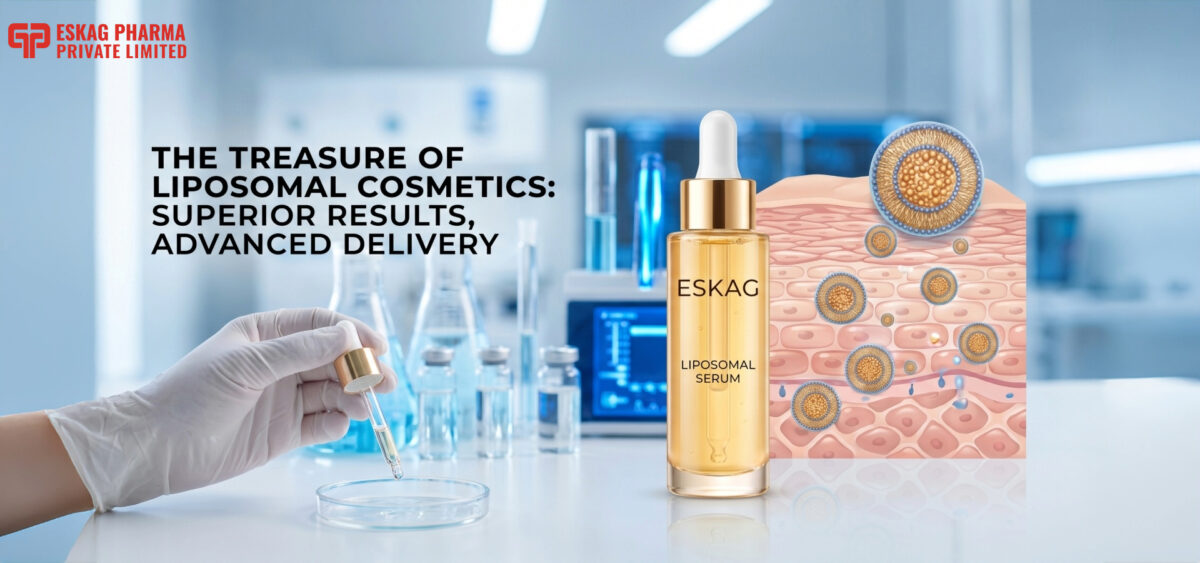
The Treasure of Liposomal Cosmetics: How Eskag’s Advanced Range Delivers Superior Results Across Skin Concerns
Over the past decade, dermatological science has undergone a paradigm shift — moving away from surface-level emollients toward precision-engineered liposomal skincare serum technology that operates at the cellular frontier. The promise is no longer mere moisturisation; it is targeted, measurable, clinically substantiated transformation. At the vanguard of this revolution stands Eskag Pharma Pvt. Ltd., a WHO-GMP certified liposomal cosmetics manufacturer delivering biopharma-grade topical solutions to brand partners worldwide.
This scientific blog draws upon peer-reviewed research indexed on PubMed and PMC to illuminate the mechanisms, active ingredients, and formulation engineering that define a truly advanced liposomal skincare serum — and to demonstrate how Eskag’s proprietary platform translates this science into commercially scalable, results-driven products.
Key Takeaways
- Depth of Delivery: Traditional topical actives accumulate in the outermost stratum corneum. A liposomal skincare serum encapsulates potent actives within a phospholipid bilayer, enabling seamless deep dermal penetration and maximising cellular-level repair (PMC 11942248; Journal of Nanobiotechnology, 2025).
- Targeting Stubborn Pigmentation: Liposomal delivery skincare stabilises volatile brightening actives, creating a potent hyperpigmentation treatment serum that safely fades persistent kojic acid dark spots and sustains alpha arbutin skin brightening without surface irritation (PMC 10094916; JCAD 2022).
- Turnkey B2B Scalability: Partnering with a premier liposomal cosmetics manufacturer allows brands to launch a fully customised, stability-tested skincare serum private label line backed by cutting-edge cosmeceutical formulation expertise and WHO-GMP compliance.
The Challenge of Effective Epidermal Penetration
Understanding the Protective Barrier Function of the Stratum Corneum
The stratum corneum (SC) — the outermost epidermal layer measuring 15–20 μm in thickness — constitutes the primary physicochemical barrier to exogenous molecule absorption (PMC 11942248). Its ‘brick-and-mortar’ architecture, comprising corneocytes (bricks) embedded within an organised lipid matrix (mortar) of ceramides, free fatty acids, and cholesterol, creates a formidable hydrophobic boundary. External molecules may traverse it via three pathways: intercellular lipid lamellae, transcellular diffusion, or appendageal routes through follicular openings (PMC 11942248).
Why Traditional Topical Creams Fail to Penetrate Deeply
Conventional emulsions and cream formulations deliver actives to the SC surface, where enzymatic degradation, photodegradation, and oxidative stress rapidly degrade them. As confirmed by PMC 7412180, classic liposomes and conventional topical formulations generally lead to compound accumulation in the SC without facilitating delivery to the hydrophilic deeper layers. This limits therapeutic efficacy even when high concentrations of active ingredient are applied. The result: diminished clinical outcomes, increased sensitisation risk from undegraded surface accumulation, and consumer disappointment.
Maximising Absorption Through Advanced Liposomal Delivery Skincare
The breakthrough lies in liposomal delivery skincare — a nanotechnological approach that harnesses the intrinsic compatibility between phospholipid vesicles and the skin’s own lipid matrix. By engineering vesicles with tunable fluidity (via incorporation of fatty acids, edge activators, or short-chain alcohols), liposomal delivery skincare platforms generate deformable carriers capable of traversing tight intercellular junctions in the SC. Research published in PMC 12110836 confirms that such fluidised vesicles outperform conventional liposomes in deeper skin permeation, offering sustained depot formation for prolonged active release.
Understanding the Science Behind a Liposomal Skincare Serum
How Phospholipid Vesicles Perfectly Mimic Human Cell Membranes
The elegance of a liposomal skincare serum lies in biomimicry. Liposomes are spherical, bilayered vesicles whose phosphatidylcholine membrane structure mirrors the lipid bilayer of human keratinocyte cell membranes. This structural homology enables membrane fusion events and receptor-independent uptake, facilitating seamless integration of encapsulated actives into the target cell milieu. Strategic advances in liposome technology (Journal of Nanobiotechnology, 2025; PMC 12369165) confirm that incorporating phospholipids into liposomal formulations enhances skin penetration and facilitates targeted delivery to specific sites of action.
Bypassing Surface Degradation for Deeper Dermal Delivery
A well-engineered liposomal skincare serum encapsulates actives within an aqueous core (for hydrophilic compounds such as alpha arbutin and kojic acid) or within the lipid bilayer (for lipophilic actives), creating a physicochemical shield against oxidation, pH-induced hydrolysis, and photodegradation. This dual-compartment architecture ensures that even chemically labile molecules like ascorbic acid derivatives and retinoids remain structurally intact until they reach the viable epidermis or dermis, where controlled release occurs through membrane fusion and enzymatic lipid hydrolysis.
Sustained Release Mechanisms of a Liposomal Skincare Serum
One of the most clinically significant advantages of a liposomal skincare serum is its capacity for sustained, controlled active release. Liposomes act as repositories for the gradual release of active substances, as confirmed by PMC 12369165. A dermal liposome depot formed within the SC can release encapsulated molecules over 8–24 hours post-application, maintaining therapeutic concentrations at the target site well beyond what conventional formulations achieve. This pharmacokinetic advantage translates to fewer applications, reduced sensitisation risk, and enhanced long-term efficacy in clinical practice.
Targeting Discoloration: The Ultimate Hyperpigmentation Treatment Serum
The Biological Process of Melanin Overproduction and Sun Damage
Hyperpigmentation — encompassing melasma, post-inflammatory hyperpigmentation (PIH), solar lentigines, and age spots — originates from aberrant upregulation of the melanogenesis cascade within melanocytes. Keratinocyte-secreted signals (endothelin-1, stem cell factor, prostaglandins) amplify melanocyte stimulating hormone (α-MSH) binding to MC1R receptors, triggering cyclic AMP–mediated induction of microphthalmia-associated transcription factor (MITF). MITF transcriptionally activates key melanogenic enzymes: tyrosinase (TYR), tyrosinase-related protein 1 (TYRP1), and dopachrome tautomerase (DCT). Excess melanin is packaged into melanosomes and transferred to surrounding keratinocytes, producing clinically visible hyperpigmented lesions.
How Deep-Penetrating Actives Inhibit Tyrosinase Enzymes
Effective design of a hyperpigmentation treatment serum demands actives capable of reaching the stratum basale — the sub-epidermal layer where active melanocytes reside. A liposome-encapsulated hyperpigmentation treatment serum achieves this by vectorially transporting tyrosinase inhibitors to the melanocyte population, producing IC₅₀-level enzyme suppression at the site of melanin synthesis rather than on the skin surface. Research indexed on PubMed (PMC 8884189) confirms that depth of active delivery is a decisive determinant of clinical depigmenting efficacy.
Erasing Stubborn Melasma with a Hyperpigmentation Treatment Serum
Melasma represents the most therapeutically challenging form of facial hyperpigmentation, as it involves both epidermal and dermal melanin deposition with a propensity for chronic relapse. Clinical evidence supports that a multi-mechanism hyperpigmentation treatment serum — synergistically combining tyrosinase inhibitors (kojic acid, alpha arbutin), antioxidants, and anti-inflammatory actives within a liposomal carrier — produces superior outcomes compared to any single active ingredient. A randomised controlled split-face study (2020) demonstrated that multi-active formulations including arbutin and tranexamic acid achieved significant melanin index reduction after 8–12 weeks of consistent use.
Synergistic Actives: Treating Kojic Acid Dark Spots
The Natural Depigmenting Power of Kojic Acid
Kojic acid (5-hydroxy-2-(hydroxymethyl)-4H-pyran-4-one) is a γ-pyrone natural product derived primarily from the filamentous fungus Aspergillus oryzae — the same koji mould employed in the fermentation of sake, soy sauce, and miso. Its molecular mechanism of depigmentation is well characterised: kojic acid acts as a copper-chelating competitive inhibitor of tyrosinase, sequestering the bivalent copper ions at the enzyme’s catalytic active site and blocking the oxidation of L-tyrosine to L-DOPA — the rate-limiting step in melanin biosynthesis (PMC 10094916). This targeted copper chelation mechanism halts the progression of kojic acid dark spots without the cellular cytotoxicity associated with hydroquinone.
Preventing Oxidation and Sensitivity Through Liposomal Encapsulation
The primary clinical limitation of conventional kojic acid formulations is their chemical instability. Kojic acid oxidises readily upon air exposure, turning yellow-brown and losing depigmenting activity. Furthermore, free kojic acid at sufficient concentrations can cause contact sensitisation and erythema in susceptible individuals (PMC 12027702). Liposomal encapsulation addresses both limitations simultaneously: the phospholipid bilayer provides an oxygen-exclusion microenvironment that preserves kojic acid’s γ-pyrone ring integrity, while the controlled release from the vesicle prevents transient surface concentration spikes that trigger sensitisation. This engineering solution transforms an efficacious but notoriously labile molecule into a clinically deployable brightening active.
Clinically Fading Kojic Acid Dark Spots for an Even Complexion
When delivered via a liposomal skincare serum, kojic acid achieves consistent, deep-penetrating tyrosinase inhibition that progressively fades kojic acid dark spots. In-vitro investigations confirm that liposomal kojic acid outperforms free kojic acid in both tyrosinase inhibitory activity and melanin content reduction in B16F10 melanoma cell models (Goldfeder et al., 2014). A comparative study reported comparable efficacy between kojic acid and hydroquinone in clinical skin lightening outcomes (JCAD 2022; PMC 8884189). Unlike hydroquinone — which functions as a melanocytotoxic agent — kojic acid selectively modulates enzymatic activity, ensuring that pigment normalisation in kojic acid dark spots occurs gradually and safely, preserving baseline melanocyte function.
Activating Glow: The Role of Alpha Arbutin Skin Brightening
How Alpha Arbutin Safely Outperforms Traditional Hydroquinone
Alpha arbutin (4-hydroxyphenyl-α-D-glucopyranoside) is a biosynthetically distinct glycosylated derivative of hydroquinone, naturally occurring in bearberry (Arctostaphylos uva-ursi), wheat, and pear. The alpha-anomeric configuration confers superior bioavailability and enzymatic stability compared to beta-arbutin. Critically, alpha arbutin skin brightening operates through reversible competitive inhibition of tyrosinase at the L-tyrosine binding site, blocking melanin synthesis without the cytotoxic and mutagenic risks associated with hydroquinone (PMC 12027702; PMC 8884189). In only intact melanocytes, both arbutin and kojic acid are confirmed to inhibit pigmentation production — a distinction that sets them apart from melanocytotoxic agents. Alpha arbutin’s 10-fold greater tyrosinase inhibitory potency versus beta-arbutin further solidifies its position as the premier safe brightening active.
Enhancing Cellular Turnover and Overall Radiance
Beyond its primary tyrosinase inhibitory action, alpha arbutin skin brightening contributes ancillary antioxidant and anti-inflammatory effects that collectively enhance epidermal cellular turnover and overall luminosity (PMC 8884189). By quenching reactive oxygen species (ROS) generated in UV-exposed keratinocytes, alpha arbutin prevents oxidative activation of the melanogenesis cascade — a secondary pathway through which photodamage amplifies pigmentation. This dual mechanism — direct enzymatic inhibition plus ROS scavenging — makes alpha arbutin a uniquely comprehensive brightening active, particularly when stabilised and deep-delivered via a liposomal skincare serum.
Achieving Long-Term Alpha Arbutin Skin Brightening Results
Clinical studies demonstrate that alpha arbutin skin brightening requires 8–12 weeks of consistent application for measurable melanin index reduction, with results visible in solar lentigines after 12 weeks (PMC 8884189). The sustained release profile of a liposomal formulation ensures that therapeutic concentrations of alpha arbutin are maintained at the stratum basale throughout this treatment window, without the concentration peaks and troughs typical of conventional serums. In a 2020 randomised split-face study, multi-active formulations incorporating arbutin produced significant pigmentation improvement with zero incidence of formulation intolerance — a safety profile that conventional hydroquinone cannot match.
Engineering a Stable Cosmeceutical Formulation
The Importance of High-Shear Microfluidization in Skincare Serums
The clinical performance of a cosmeceutical formulation is inextricably linked to its manufacturing precision. High-shear microfluidization — the process of forcing lipid dispersions through an interaction chamber under pressures of 5,000–30,000 psi — produces monodisperse liposomal vesicles with controlled particle size distributions (typically 50–200 nm). Recent microfluidics research published on PubMed (PMC 12655562) demonstrates that optimal microfluidic conditions can yield ultradeformable liposomes with a mean size of 89 ± 1 nm, a polydispersity index (PDI) < 0.25, and encapsulation efficiency of 72% — producing a 2-fold increase in dermal permeation rate compared to free active extracts. These parameters are critical quality attributes (CQAs) that directly govern the cosmeceutical formulation‘s in-vivo performance.
Balancing pH Levels to Prevent Active Ingredient Degradation
Formulation pH is a critical determinant of active ingredient stability and skin compatibility. The physiological pH of healthy skin surface is 4.5–5.5. A cosmeceutical formulation designed for epidermal application must maintain formulation pH within this acidic range to: (1) preserve kojic acid’s γ-pyrone ring from alkaline hydrolysis; (2) prevent alpha arbutin hydrolysis to hydroquinone (which occurs at elevated pH); (3) maintain liposome bilayer structural integrity; and (4) support the skin’s acid mantle barrier function. Eskag’s formulation scientists employ precision buffering systems, nitrogen-blanketed manufacturing environments, and photostable packaging to ensure that each liposomal skincare serum maintains target pH throughout its stated shelf life.
Rigorous Dermatological Stability Testing for a Premium Cosmeceutical Formulation
ICH-guideline-aligned accelerated stability studies (40°C/75% RH; 25°C/60% RH; 4°C refrigerated and 50°C stress conditions) are conducted on each cosmeceutical formulation batch. Assessments include: zeta potential (target: ≤ –30 mV for colloidal stability), vesicle size by dynamic light scattering (DLS), encapsulation efficiency (HPLC-UV), pH monitoring, organoleptic evaluation, and dermatologist-supervised repeat insult patch testing (RIPT) on a minimum of 50 volunteers. This comprehensive stability programme, conducted under WHO-GMP–governed documentation protocols, underpins the safety dossiers required for regulatory submission in the EU (Cosmetic Regulation EC 1223/2009), USA (FDA OTC/Cosmetic), and ASEAN markets.
Commercial Scalability: Launching Your Skincare Serum Private Label
The Surging Market Demand for Science-Backed Clinical Beauty
The global liposome-in-cosmetics market was valued at approximately USD 6.5 billion in 2024 and is projected to expand to USD 12.8 billion by 2033 at a CAGR of 7.8% (Verified Market Reports, 2025). Within this growth, skincare accounts for approximately 60% of total liposome cosmetics demand, propelled by consumer desire for evidence-based, dermatologist-grade solutions. The liposomal cosmetic ingredients segment alone was valued at USD 1.2 billion in 2024 and is forecast to grow at 8.5% CAGR through 2033 (Verified Market Reports, 2025). For brands seeking skincare serum private label opportunities, this macroeconomic backdrop represents a powerful commercial mandate.
Accelerating Speed-to-Market with Ready-to-Launch White Label Formulas
Eskag Pharma’s skincare serum private label programme provides B2B brand partners with access to a curated library of pre-validated, stability-tested liposomal skincare serum formulations — each with complete regulatory dossiers, INCI declarations, safety data sheets, and dermatological study summaries. This ready-to-launch infrastructure compresses the typical product development timeline from 18–24 months to as little as 90 days, enabling agile brands to capitalise on emerging market trends. Skincare private label products now account for 25% of the global cosmetics contract manufacturing market, with online sales growing 20% annually in emerging regions (Global Growth Insights, 2024).
Customising High-Performance Actives for Your Skincare Serum Private Label
Beyond ready-to-launch SKUs, Eskag’s bespoke skincare serum private label development service enables full active customisation — adjusting concentrations of kojic acid, alpha arbutin, niacinamide, retinol, hyaluronic acid, and peptides within proprietary liposomal carrier systems. Brand partners specify target skin concerns, regional regulatory requirements, sustainability preferences (vegan, organic-certified phospholipids), and price positioning, and Eskag’s formulation scientists engineer a liposomal skincare serum to specification — complete with proprietary delivery optimisation data and third-party clinical efficacy validation.
Partnering with an Expert Liposomal Cosmetics Manufacturer
Utilising WHO-GMP Certified Cleanroom Facilities for Skincare Production
Quality in liposomal delivery skincare manufacturing is non-negotiable. Liposome production demands ISO Class 7/8 cleanroom environments to prevent particulate and microbial contamination of the nano-scale vesicular systems. Eskag Pharma’s manufacturing facility operates under WHO-GMP guidelines, with validated air handling, water-for-injection (WFI)-quality purified water systems, pressure differentials between zones, environmental monitoring, and full batch traceability via 21 CFR Part 11-aligned electronic batch records. As a WHO-GMP–certified liposomal cosmetics manufacturer, Eskag offers brand partners manufacturing transparency, audit rights, and Certificate of Analysis documentation for every production batch.
Ensuring Microbiological Safety and Dermatological Compliance
As a responsible liposomal cosmetics manufacturer, Eskag Pharma conducts compendial microbiological testing (USP <51>, USP <61>, USP <62>) on all finished formulations, verifying compliance with preservation efficacy criteria (PTCA/PTCB targets). Dermatological safety is confirmed through primary irritation testing (Draize method adaptation), sensitisation screening (LLNA surrogate data where applicable), RIPT on 50+ volunteers, and ophthalmological compatibility testing for eye-area products. Regulatory submission packages — including Product Information Files (EU PIF), Cosmetic Product Safety Reports (CPSR), and Responsible Person (RP) designations — are prepared in-house, streamlining market access for brand partners.
Why Choose Eskag Pharma as Your Strategic Liposomal Cosmetics Manufacturer
Eskag Pharma represents the convergence of pharmaceutical-grade manufacturing rigour with cosmetic innovation and B2B agility. As a dedicated liposomal cosmetics manufacturer, Eskag delivers: (1) proprietary high-shear microfluidization capability for monodisperse liposomal skincare serum production; (2) full-spectrum cosmeceutical formulation R&D, from active selection through stability validation; (3) scalable skincare serum private label programmes with 90-day speed-to-market timelines; (4) WHO-GMP cleanroom manufacturing with complete audit transparency; and (5) regulatory affairs support for EU, USA, India (CDSCO), and ASEAN market filings.
Whether you are launching a clinical brightening line targeting kojic acid dark spots, developing a physician-dispensed hyperpigmentation treatment serum, or building a comprehensive alpha arbutin skin brightening portfolio, Eskag’s integrated platform transforms scientific innovation into market-ready, dermatologically validated products. The treasure of liposomal cosmetics is not merely in the science — it is in the partner who makes that science commercially real.
Conclusion
The evidence base from PubMed-indexed literature is unambiguous: liposomal delivery skincare technology represents the most scientifically validated pathway to meaningful, measurable skin transformation. A premium liposomal skincare serum — one engineered with pharmaceutical microfluidization, stabilised with precision pH control, and validated through rigorous dermatological testing — does not merely sit on the skin’s surface. It enters it, targets it, and transforms it at the cellular level.
For B2B brand partners seeking to position at the forefront of the clinical beauty market, the path is clear: partner with a WHO-GMP–certified liposomal cosmetics manufacturer whose cosmeceutical formulation capabilities match the ambition of your brand. With Eskag Pharma, your skincare serum private label product is not a cosmetic — it is a clinically substantiated dermatological asset.

-
 📅 September 22, 2026
Anaemia is common once kidneys fail. Blood loss on... -
 📅 September 22, 2026
Coenzyme Q10 sits at the centre of how cells make ... -
 📅 June 30, 2026
Key Takeaways The Bioavailability Challenge: Stand... -
 📅 June 29, 2026
Over the past decade, dermatological science has u... -
 📅 June 27, 2026
The global nutraceutical industry faces a critical... -
 📅 June 27, 2026
Iron deficiency anaemia remains the most prevalent... -
 📅 June 26, 2026
Uneven skin tone, persistent redness, and acne tha... -
 📅 June 26, 2026
If you struggle to switch off after a long day, yo... -
 📅 June 26, 2026
India’s sleep aid market is on course to rea... -
 📅 June 26, 2026
Key Takeaways The First-Pass Barrier: Traditional ...
Liposomal serums encapsulate actives in phospholipid vesicles, enhancing penetration through the skin barrier. This improves bioavailability, stability, and targeted delivery compared to water-based serums, which often degrade quickly and remain on the surface.
Liposomes release actives gradually and in controlled amounts, reducing direct exposure to high concentrations. This minimizes irritation, making potent ingredients like acids or vitamins gentler and more suitable for sensitive skin types.
Yes, liposomal formulations allow controlled release of depigmenting agents, making them safer for daily use. However, consistent sunscreen use and dermatological guidance are essential when treating melasma for effective and safe results.
Visible improvement typically begins within 2–4 weeks, with more significant reduction over 6–8 weeks. Results vary based on skin type, concentration, and consistency of use, along with sun protection practices.
Alpha arbutin is considered safer for long-term use as it releases hydroquinone slowly and in lower concentrations. It offers effective brightening with reduced risk of irritation or ochronosis compared to direct hydroquinone application.
It involves selecting suitable phospholipids, optimizing encapsulation efficiency, ensuring particle size stability, preventing oxidation, conducting compatibility studies, and validating shelf-life through stability and microbiological testing.
Encapsulation shields sensitive actives within lipid bilayers, limiting exposure to air, light, and moisture. This significantly reduces oxidation, preserves potency, and extends shelf life compared to unprotected formulations.
It offers product differentiation, enhanced efficacy claims, improved stability, and premium positioning. Brands can attract discerning consumers seeking advanced skincare while benefiting from scalable, science-backed formulations.
Brands should require GMP compliance, validated encapsulation efficiency, particle size analysis, stability testing, microbial limits, and proper documentation. Transparent quality systems ensure safety, consistency, and regulatory compliance.
Yes, Eskag Pharma supports custom formulation development, including liposomal technologies, tailored to brand requirements. They also assist with product selection, quality assurance, and scalable manufacturing solutions for dermatology-focused businesses.