
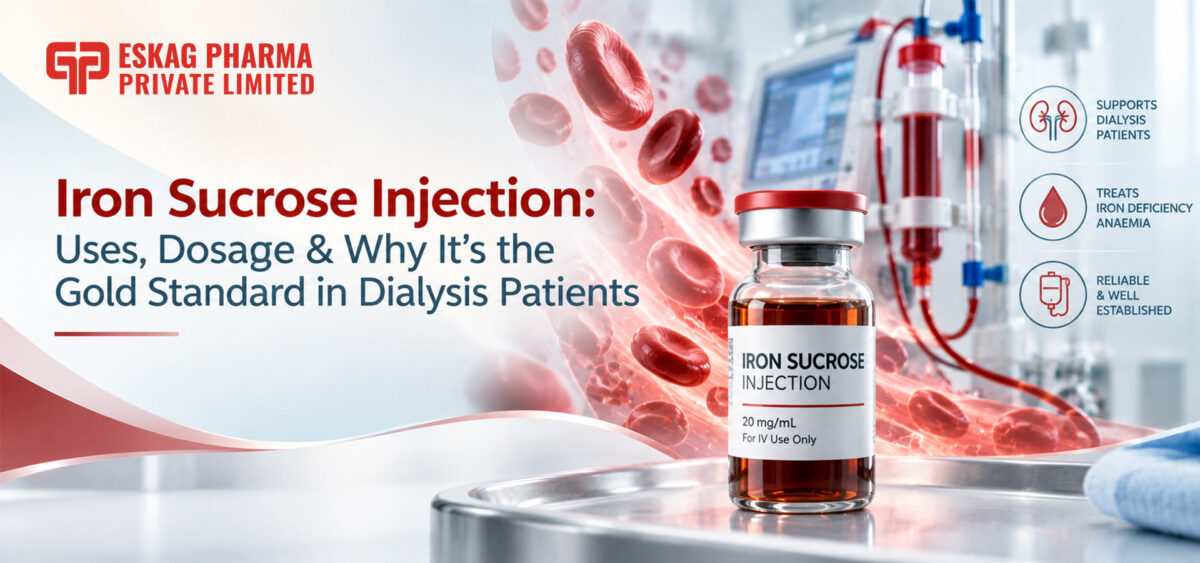
Iron Sucrose Injection: Uses, Dosage & Why It’s the Gold Standard in Dialysis Patients
Anaemia is common once kidneys fail. Blood loss on the circuit, low erythropoietin, and high hepcidin all drain iron. Oral tablets often sit unused in the gut. This guide sets out iron sucrose injection uses in haemodialysis and peritoneal dialysis. It also covers dose, safety, and how brands source a WHO-GMP injectable supply.
Key Takeaways
- The clinical case for IV iron. Chronic kidney disease drains iron stores and lowers haemoglobin. Reviewing iron sucrose injection uses shows why elemental iron given into the vein during dialysis replenishes stores faster than the gut can.
- Absorption versus tablets. In iron sucrose vs oral iron, tablets often fail in dialysis because of gut intolerance and inflammation. Intravenous delivery puts iron into plasma without relying on intestinal uptake.
- B2B production quality. A sterile colloidal iron complex needs aseptic filling and tight analytic control. Brands scale hospital ranges through iron sucrose injection third party partners and a WHO-GMP iron sucrose injection Manufacturer.
The Growing Burden of Anaemia in Chronic Kidney Disease
Anaemia of chronic kidney disease is not a mild laboratory finding. It cuts exercise capacity, raises cardiac work, and shortens quality of life. Most people on long-term dialysis will need a structured intravenous iron plan at some point.
Guidelines now treat iron repletion as a first step, not an afterthought. The aim is a safe haemoglobin rise with the lowest useful dose of an erythropoiesis-stimulating agent.
How Chronic Kidney Disease Depletes Haemoglobin and Iron Stores
Failing kidneys make less erythropoietin. Red cell production then slows even when iron is present. Inflammation also raises hepcidin. Hepcidin traps iron inside stores and blocks gut absorption.
Haemodialysis adds further loss. Blood remains in the circuit. Frequent sampling removes more. Hidden gut bleeding is common. Annual iron loss on haemodialysis often reaches one to two grams.
Absolute iron deficiency shows a low ferritin and a low transferrin saturation. Functional deficiency shows a higher ferritin with a still-low saturation. Both patterns appear in clinic. Both sit inside standard iron sucrose injection uses for CKD anaemia.[8]
The Vital Need for a Fast-Acting, Intravenous Dialysis Iron Treatment
Oral ferrous salts must survive acid, transporters, and hepcidin. In inflamed dialysis patients that path is weak. Waiting months for a tablet response delays recovery and can raise transfusion risk.
An intravenous complex reaches macrophages and then the marrow within hours to days. That speed is why unit protocols are built around IV products rather than a tablet chart.
KDIGO 2026 still prefers intravenous iron over oral iron when anaemia is treated in people on haemodialysis.[4] UK practice points make the same call for most in-centre patients.[6]
The Systemic Impact of Unmanaged Anaemia on Heart Health and Energy
Low haemoglobin forces the heart to pump a larger volume. Over time that load can worsen left ventricular strain. Patients feel the change as breathlessness, cold hands, and a heavy fatigue.
Correcting iron and haemoglobin does not replace dialysis or blood-pressure care. It does reduce one driver of cardiac stress. Fewer transfusions also spare HLA sensitisation before transplant.
Related hospital iron options sit in Eskag’s intravenous iron therapy overview and in the ferric carboxymaltose anaemia guide.
The Clinical Significance of Iron Sucrose Injection Uses
Iron sucrose is a polynuclear iron(III)-hydroxide complex bound to sucrose. After infusion the particles are taken up by the reticulo-endothelial system. Iron then joins transferrin and ferritin in a controlled way.
Licensed iron sucrose injection uses centre on iron-deficiency anaemia in chronic kidney disease. That includes people on haemodialysis, people on peritoneal dialysis, and selected non-dialysis CKD patients.[5][8]
Immediate Replenishment of Deep Tissue and Intravenous Iron Stores
A single 100 mg or 200 mg dose does not refill the whole-body deficit. A planned course of about 1,000 mg often does. Ferritin and TSAT then rise in parallel with haemoglobin.
In non-dialysis CKD, divided intravenous iron sucrose raised haemoglobin more than oral ferrous sulphate in a randomised trial. More patients gained at least 1 g/dL.[1]
A second randomised study found similar haemoglobin change but a far larger ferritin rise with IV iron. Oral iron barely moved stores.[2]
Primary Iron Sucrose Injection Uses in Haemodialysis and Peritoneal Dialysis
On haemodialysis the dose is given early in the session, usually in the first hour. The nurse can watch blood pressure while the circuit is already running. That setting is one reason iron sucrose injection uses became routine on dialysis units.
Peritoneal dialysis patients do not attend three times a week. They still lose iron and still respond. A Chinese study in peritoneal dialysis found higher haemoglobin and iron indices with IV iron sucrose than with oral ferrous succinate. Erythropoietin doses also fell.[7]
Newer high-dose complexes exist for fewer visits. They include iron isomaltoside (ferric derisomaltose) and ferric carboxymaltose. Iron sucrose remains the workhorse where small, frequent doses fit the dialysis timetable.
Maximising Synergy with Erythropoiesis-Stimulating Agents (ESAs)
ESAs drive the marrow to make red cells. That work consumes iron. If stores are empty, the ESA dose climbs and the haemoglobin stalls. This is iron-restricted erythropoiesis.
The PIVOTAL trial tested this idea in 2,141 UK haemodialysis patients. A proactive high-dose iron sucrose plan cut ESA use and reduced the composite of death and major cardiovascular events versus a reactive low-dose plan.[3][9]
Infection rates were not higher in the proactive arm. That finding eased a long-standing fear that more IV iron must mean more sepsis.
Efficacy Showdown: Iron Sucrose vs Oral Iron
Choosing the vein or the tablet is not a marketing slogan. It is a daily choice on the ward. The gut and the vein are not equal routes in uraemia.
The Mechanism of Poor Oral Iron Absorption in Renal Patients
Hepcidin blocks ferroportin. Ferroportin is the door that lets iron leave the enterocyte. High hepcidin therefore parks oral iron inside the gut cell. The tablet is taken. Little iron reaches plasma.
Phosphate binders, proton-pump inhibitors, and food phytates add further interference. Many patients already swallow a large tablet burden. Another three-times-daily iron salt is a poor extra load.
Preventing Severe Gastrointestinal Irritation and Severe Constipation
Ferrous sulphate often causes nausea, dark stools, cramp, and constipation. Those effects drive missed doses. Missed doses then look like “oral iron failure” when the true problem is adherence.
Intravenous iron sucrose avoids the gut wall. It does not remove all risk. It does remove the most common reason patients stop oral therapy.
Why Global Clinical Guidelines Heavily Favour Iron Sucrose vs Oral Iron
KDIGO 2026 suggests IV iron rather than oral iron when treatment starts in haemodialysis anaemia. For non-dialysis and peritoneal dialysis the choice can be oral or IV, based on preference, severity, cost, and tolerance.[4]
UK Kidney Association guidance likewise states that most people on haemodialysis need IV iron. A proactive monthly plan modelled on PIVOTAL is now a recognised option.[6]
When teams write that comparison into a protocol, they are following that evidence, not discarding tablets for fashion.
Typical contrast in dialysis-era anaemia care
| Factor | Oral iron salts | Iron sucrose (IV) |
| Route | Gut absorption | Direct intravenous delivery |
| Effect of hepcidin | Strongly limits uptake | Bypasses the enterocyte |
| Common intolerance | Nausea, constipation, metallic taste | Transient hypotension, headache |
| Store repletion | Often slow or absent in HD | Ferritin and TSAT rise in a planned course |
| Fit with HD session | Relies on home adherence | Can be given on the unit |
| Guideline stance in HD | Not first choice for most | Preferred initial iron route |
Calculating the Optimal Iron Sucrose Injection Dose
Dose is not a brand slogan. It follows the licensed label, the local protocol, and the latest iron studies. The figures below are typical adult regimens from public prescribing information. They are not a prescription and not an Eskag pack claim.
Clinicians still individualise every intravenous iron amount against weight, haemoglobin, ferritin, TSAT, and recent blood loss.[5]
Differentiating Between Maintenance Dosing and Aggressive Repletion Protocols
Repletion treats a documented deficit. A common adult course is 1,000 mg elemental iron split across several sessions. Maintenance then replaces ongoing dialysis losses so stores do not fall again.
PIVOTAL used a proactive maintenance idea. Patients received 400 mg iron sucrose each month unless ferritin rose above 700 µg/L or TSAT reached 40% or more.[3]
Reactive care waited for ferritin below 200 µg/L or TSAT below 20%. The proactive arm used more iron. It also used less ESA and recorded fewer primary events.
Adjusting the Iron Sucrose Injection Dose for Adult Haemodialysis Patients
On the US label, adult haemodialysis-dependent CKD often receives 100 mg elemental iron per session. The injection may be slow and undiluted over two to five minutes. It may also be diluted in up to 100 mL of 0.9% sodium chloride and infused over at least 15 minutes.[5]
Non-dialysis CKD often uses 200 mg per visit. Peritoneal dialysis often uses 300 mg, then 300 mg, then 400 mg, two weeks apart, to complete about 1,000 mg.
Give the dose early in haemodialysis. Hold the product if there is clear iron overload. Do not draw a serum iron level for at least 48 hours after a dose, because TSAT spikes and misleads.
Typical licensed adult regimens (public label; confirm local SmPC)
| Setting | Usual single dose | Usual course idea |
| Haemodialysis CKD | 100 mg elemental iron | About 1,000 mg across sessions |
| Non-dialysis CKD | 200 mg elemental iron | About 1,000 mg in divided visits |
| Peritoneal dialysis CKD | 300 mg then 400 mg infusions | About 1,000 mg over 28 days |
| PIVOTAL-style HD maintenance | Up to 400 mg per month | Hold if ferritin >700 µg/L or TSAT ≥40% |
The Importance of Monitoring Serum Ferritin and TSAT Levels During Therapy
KDIGO 2026 suggests starting iron in haemodialysis anaemia when ferritin is 500 ng/mL or lower and TSAT is 30% or lower. It is reasonable to withhold routine iron if ferritin exceeds 700 ng/mL or TSAT is 40% or higher.[4][10]
Check haemoglobin, ferritin, and TSAT every one to three months on haemodialysis. Check about every three months off haemodialysis. Recheck sooner after a bleed, a transfusion, or an ESA change.
Ferritin is an acute-phase protein. A high value in sepsis does not prove iron overload. Read it with CRP, TSAT, and the clinical picture.
Why It Remains the Gold Standard for Dialysis Iron Treatment
Newer complexes allow larger single doses. That helps outpatients who travel. On the haemodialysis floor, small repeated doses still match the three-times-weekly rhythm. That is why many units still start with iron sucrose.
Consistent Efficacy in Elevating Haemoglobin Safely Without Iron Overload
Head-to-head trials against ferumoxytol and iron isomaltoside show similar haemoglobin gains when total iron dose is matched. The difference is visit count, not marrow response.
Safety hinges on not chasing ever-higher ferritin. Hold rules, not product mystique, prevent iatrogenic overload.
Drastically Reducing the Frequent Need for Whole Blood Transfusions
PIVOTAL reported fewer transfusions in the proactive iron sucrose arm as well as lower ESA doses.[3] Each avoided unit reduces infection risk, volume load, and future transplant sensitisation.
Transfusion remains right for acute bleeding or unstable coronary disease. It should not be the default anaemia plan on chronic dialysis.
The Real-World, Long-Term Clinical Success of Dialysis Iron Treatment
Units that pair a written iron protocol with monthly labs see fewer crash haemoglobin drops. Nurses know when to give, when to hold, and when to call the nephrologist.
Portfolio planning for hospitals now often includes more than one IV iron. Eskag’s public injectable list already covers iron hydroxide polymaltose complex and iron isomaltoside for CKD anaemia. Iron sucrose sits in the same clinical family.
Recognising and Managing Iron Sucrose Side Effects
No intravenous iron is free of risk. Most reactions are short-lived and dose-related. Serious hypersensitivity is uncommon, but every infusion chair needs a plan.
Understanding Common Infusion Reactions and Transient Hypotension
Labelled reactions include hypotension, headache, nausea, vomiting, diarrhoea, taste change, and injection-site pain.[5] A fishy or metallic taste during the infusion is well described and usually brief.
Hypotension is more likely if a large dose runs too fast, especially in smaller adults. Slow the rate. Recheck volume status. Do not assume every pressure drop is anaphylaxis.
True anaphylaxis is rare with iron sucrose and historically far less frequent than with older high-molecular-weight iron dextran. Still observe the patient after the dose.
Clinical Preventative Strategies to Minimise Iron Sucrose Side Effects
Use the licensed rate. Give early in the dialysis session. Avoid extra large off-label boluses in low-weight patients. Keep resuscitation medicines on the unit.
Do not give the product into a muscle or under the skin. It is for intravenous use only. Extravasation can stain tissue.
If a mild reaction occurs, many teams restart later at a slower rate after clinical review. A severe reaction means stop, treat, and choose a different complex only under specialist advice.
Why the Overall Safety Profile Is Markedly Superior to High-Molecular Iron Dextran
High-molecular-weight iron dextran carried a boxed warning and a test-dose ritual for a reason. Life-threatening events were reported at a higher rate than with iron sucrose in older pharmacovigilance series.
Modern non-dextran complexes, including iron sucrose, still need observation. They do not need the same historic fear. That safety margin is a core reason iron sucrose injection uses spread so widely after 2000.
Counsel patients in plain words. Most people feel little. A few feel dizzy or sick. Call the nurse at once if breathing or swelling changes.
Meeting the Demand for Iron Sucrose Injection Third Party Manufacturing
Hospital brands rarely build a sterile suite for one SKU. They buy finished packs from a contract plant. Demand for contract iron sucrose capacity tracks the rise in dialysis programmes across Africa, LATAM, the Middle East, and South Asia.
Eskag Pharma already runs contract work across pharmaceuticals, nutraceuticals, cosmeceuticals, and injectables from its WHO-GMP site in SIDCUL, Haridwar. See the product portfolio and company profile.
The Complex Aseptic Setup Required for Sterile Parenteral Production
Iron sucrose is a colloidal dispersion, not a simple salt solution. Particle size, free iron, pH, and sucrose binding must stay inside a narrow window. A drift in any one of those can change safety.
Eskag describes Grade A laminar filling in Class C rooms, sterility tests, bacterial endotoxin (LAL) checks, and particulate testing to pharmacopoeial limits on its injectable manufacturing page.
Those controls are the minimum bar for any contract iron sucrose brief. Buyers should also ask for method validation on free iron and heavy metals.
Scaling Clinical Portfolios via Iron Sucrose Injection Third Party Services
A marketing company can add iron sucrose beside FCM and isomaltoside without owning a vial line. The contract file should cover artwork, stability, batch records, and export dossiers.
Eskag’s public iron range already includes high-dose and classic complexes. Market notes sit in the advanced iron injectable products article. Contract iron sucrose supply lets a brand fill the frequent-dose slot those articles describe.
Do not promise a named country registration until the dossier exists. Plant capability is not the same as a granted marketing authorisation.
Meeting Strict Global WHO-GMP Export and Compliance Standards
Buyers should inspect the current WHO-GMP certificate, the site master file, and recent audit close-outs. Ask how deviations are trended. Ask who releases each sterile batch.
A practical checklist is set out in Eskag’s guide on how to evaluate a WHO-GMP third-party manufacturer. Use it before you sign an iron sucrose volume contract.
Partnering with a World-Class Iron Sucrose Injection Manufacturer
Choosing a sterile iron partner is a quality decision first and a price decision second. A cheap vial that fails sterility or free-iron specs is not cheap.
Specialised Cleanroom Facilities and Advanced R&D Analytical Testing
Look for segregated parenteral areas, validated sterilising filters, and media-fill history. The lab must assay elemental iron, sucrose, pH, osmolarity, visible and sub-visible particles, and bacterial endotoxin.
Stability work should cover both real-time and accelerated ICH conditions. Export partners will ask for that data pack with the first shipment.
Comprehensive Quality Control and Raw Material Heavy Metal Assays
Iron raw material can carry other metals if the source is poorly controlled. A serious sterile plant assays heavy metals on incoming lots and on finished product.
Keep retain samples. Keep a documented complaint path for hospitals. Dialysis units notice colour change, particles, and unusual infusion events very quickly.
Why Choose Eskag Pharma as Your Strategic Iron Sucrose Injection Manufacturer
Eskag Pharma Pvt. Ltd. is a WHO-GMP contract manufacturer with a corporate office in Salt Lake, Kolkata, and production at SIDCUL, Ranipur, Haridwar. The public site lists injectables among its finished-dose forms, including several intravenous iron complexes.
The company also states ISO 9001 and HACCP certification and support for third-party and export documentation. Those facts matter more than slogans.
If you need an iron sucrose injection Manufacturer for hospital or export work, start with a technical discussion rather than a price-only tender. Write to Eskag through the enquiry page or review about Eskag Pharma first.
This article does not invent pack strengths, MOQs, or Eskag-only clinical trials. Those details belong in a controlled quotation and a registered label.
Conclusion
Anaemia of CKD is predictable. Iron loss on dialysis is predictable. What varies is whether the unit has a clear protocol and a reliable vial. That is the practical heart of iron sucrose injection uses today.
PIVOTAL and current KDIGO text support intravenous iron on haemodialysis, with holds based on ferritin and TSAT. Oral salts still have a place off dialysis when the gut cooperates. They are a weak plan for most in-centre patients.
Dose from the label. Watch the chair for hypotension. Recheck stores on a calendar, not by guesswork. Brands that want durable hospital supply should pair that clinical picture with a WHO-GMP sterile partner.
Eskag Pharma can discuss iron sucrose injection uses in a contract-manufacturing brief alongside its wider injectable iron range. Bring your target markets, dossier needs, and forecast. The clinical case is already written in the guidelines.

References
- Van Wyck DB, Roppolo M, Martinez CO, Mazey RM, McMurray S. A randomized, controlled trial comparing IV iron sucrose to oral iron in anemic patients with nondialysis-dependent CKD. Kidney Int. 2005;68(6):2846–2856. PubMed 16316362.
- Charytan C, Qunibi W, Bailie GR. Comparison of intravenous iron sucrose to oral iron in the treatment of anemic patients with chronic kidney disease not on dialysis. Nephron Clin Pract. 2005;100(3):c55–c62. PubMed 15824508.
- Macdougall IC, White C, Anker SD, et al. Intravenous iron in patients undergoing maintenance hemodialysis (PIVOTAL). N Engl J Med. 2019;380(5):447–458. NEJM full text.
- Kidney Disease: Improving Global Outcomes (KDIGO) Anemia Work Group. KDIGO 2026 Clinical Practice Guideline for the Management of Anemia in CKD. Kidney Int. 2026. KDIGO 2026 guideline.
- U.S. National Library of Medicine. Iron sucrose injection — prescribing information. DailyMed. DailyMed iron sucrose label.
- UK Kidney Association. Clinical practice guideline: update of anaemia of chronic kidney disease. BMC Nephrol. 2025. UKKA anaemia guideline.
- Li H, Wang SX. Intravenous iron sucrose in peritoneal dialysis patients with renal anemia. Perit Dial Int. 2008. PubMed 18332450.
- Wikipedia contributors. Iron sucrose. Wikipedia. Iron sucrose encyclopaedia entry.
- Macdougall IC, et al. PIVOTAL trial record. PubMed 30365356. PubMed 30365356.
- KDIGO. Executive summary of the 2026 anemia in CKD guideline. Kidney Int. 2026. KDIGO 2026 executive summary.
-
 📅 September 22, 2026
Anaemia is common once kidneys fail. Blood loss on... -
 📅 September 22, 2026
Coenzyme Q10 sits at the centre of how cells make ... -
 📅 June 30, 2026
Key Takeaways The Bioavailability Challenge: Stand... -
 📅 June 29, 2026
Over the past decade, dermatological science has u... -
 📅 June 27, 2026
The global nutraceutical industry faces a critical... -
 📅 June 27, 2026
Iron deficiency anaemia remains the most prevalent... -
 📅 June 26, 2026
Uneven skin tone, persistent redness, and acne tha... -
 📅 June 26, 2026
If you struggle to switch off after a long day, yo... -
 📅 June 26, 2026
India’s sleep aid market is on course to rea... -
 📅 June 26, 2026
Key Takeaways The First-Pass Barrier: Traditional ...
Iron sucrose treats iron-deficiency anemia in CKD, including hemodialysis, peritoneal, and non-dialysis patients, and other hospital cases needing rapid IV iron when oral therapy fails.
US labeling uses 100 mg elemental iron per consecutive hemodialysis session, usually totaling 1000 mg. Some protocols calculate deficit using Ganzoni plus iron studies.
Nephrologists prefer IV because CKD-related hepcidin blocks oral absorption. Tablets cause GI intolerance, poor adherence, and inferior hemoglobin and ESA-sparing responses versus intravenous iron.
Ferritin and TSAT rise within days. Reticulocytes appear in about one week. Hemoglobin usually rises over two to four weeks; energy follows the anemia correction.
Watch for hypotension, muscle cramps, nausea, headache, dizziness, metallic taste, and flushing. Rare hypersensitivity can occur; monitor patients during infusion and for thirty minutes afterward.
PIVOTAL found proactive high-dose iron sucrose, paused at high ferritin or TSAT, safer and better than reactive low-dose therapy. Unmonitored high dosing is not recommended.
Third-party manufacturing avoids sterile-plant capital cost, speeds market entry, adds flexible capacity, and supplies private-label packs plus regulatory files without building an in-house injectable facility.
Experts use validated aseptic filling in ISO Class 5 areas, Water-for-Injection, sterile filtration, environmental monitoring, container-closure integrity checks, and batch sterility testing before final release.
No major pharmacokinetic clash with usual blood-pressure or heart medicines is documented. Infusion hypotension can add to antihypertensive effects; give slowly and monitor vitals.
WHO-GMP proves sterile injectables meet internationally recognized quality systems. Importers, ministries, and tenders usually require it for registration, COPP issuance, inspections, and safe cross-border supply.