
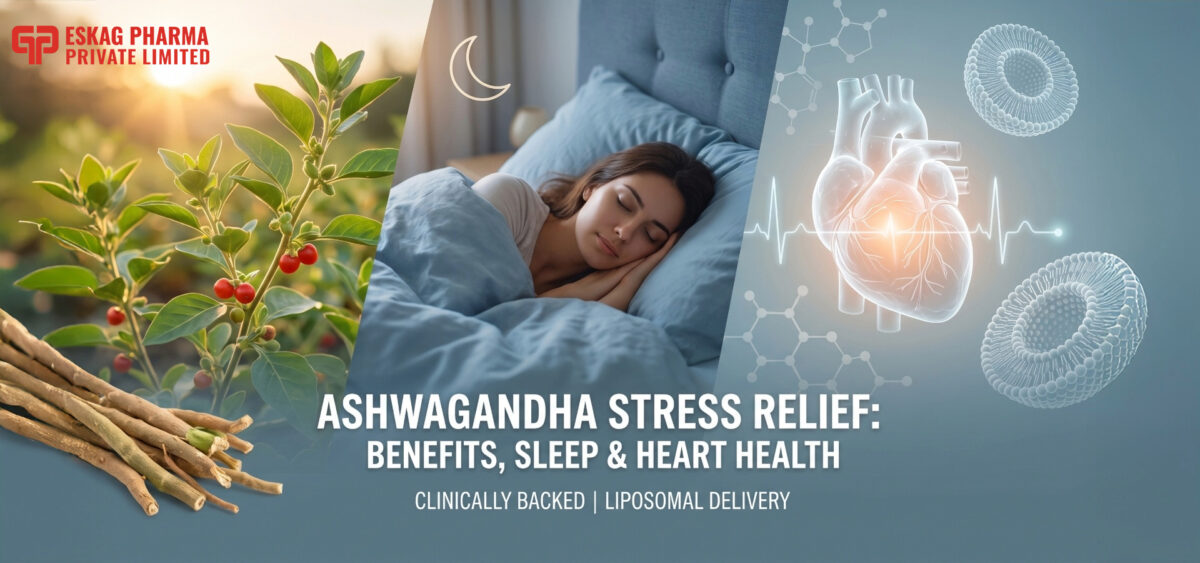
Ashwagandha Stress Relief: Benefits, Sleep & Heart Health
If you struggle to switch off after a long day, you are not alone; stress-driven sleep disruption and cognitive fatigue now affect a significant proportion of India’s working population. The body’s stress hormone, cortisol, sits at the centre of this problem: when it remains elevated into the evening, sleep onset is delayed, focus deteriorates, and recovery suffers. Most people reach for supplements that promise relief but deliver inconsistent results, largely because standard extracts lose potency before they reach the bloodstream. Ashwagandha stress relief offers a more precise answer, one grounded in over two decades of clinical research across cortisol regulation, sleep architecture, cognitive function, and cardiovascular markers.
In this guide, you will find the mechanisms, clinical evidence, and formulation decisions that distinguish a genuinely effective liposomal ashwagandha capsule from a generic root powder.
Key Takeaways:
- Ashwagandha reduces serum cortisol by up to 27.9%, but biochemical reduction does not always guarantee subjective stress relief.
- Triethylene glycol, not withanolides, is the primary sleep-inducing compound in ashwagandha, and it requires whole-plant extraction.
- Liposomal ashwagandha capsules significantly increase bioavailability compared with standard root extract, as confirmed by a 2024 clinical trial.
Quick Answer: Ashwagandha stress relief works by modulating the HPA axis, reducing cortisol by up to 27.9%, and supporting GABA signalling and NREM sleep through triethylene glycol at 300-600 mg/day.
Ashwagandha Stress Relief: How Withanolides Work
Ashwagandha stress relief works through withanolides, steroidal lactones that directly modulate your body’s stress hormone system. These bioactive compounds target the HPA axis, the biological pathway that controls cortisol production under stress.
- Withanolides suppress CRH production: Corticotropin-releasing hormone triggers the cortisol cascade. Withaferin A and withanolide D reduce its output at the hypothalamic level, cutting stress signalling at the source.
- The HPA axis returns to a regulated state: Chronic stress keeps cortisol chronically elevated. Withanolides restore glucocorticoid receptor sensitivity, allowing the feedback loop to function normally again.
- GABA-A receptors are directly modulated: Withanolides bind to GABA-A receptors, producing anxiolytic effects without sedation, a key clinical distinction from prescription anxiolytics.
- Cortisol drops by a measurable margin: A 2024 meta-analysis across 9 randomised controlled trials confirmed ashwagandha reduced serum cortisol by up to 27.9% at 300-600 mg/day over 60-90 days [1].
- Biochemical reduction does not guarantee subjective relief: A separate 2025 meta-analysis confirmed a significant reduction in cortisol but found no statistically significant improvement in perceived stress scores across all trials, a nuance brands must not overlook when making claims.
The evidence for ashwagandha’s effects on sleep goes beyond stress reduction; it targets sleep through an entirely separate biological mechanism.
Ashwagandha for Sleep: Mechanisms and Evidence
Ashwagandha stress relief extends beyond cortisol; its sleep benefits operate through a structurally distinct compound that works independently of withanolides.
- Triethylene glycol (TEG) is the primary sleep-inducing compound. Research confirmed that the alcoholic extract high in withanolides failed to induce sleep in mice. The water extract containing TEG significantly increased NREM sleep [2].
- TEG promotes NREM sleep without sedation or dependency. Unlike sedative-hypnotics, TEG does not suppress REM architecture or create withdrawal risk, a clinically meaningful distinction for any stress relief supplement positioned for nightly use.
- Sleep quality improvement is clinically documented. A 6-week trial in 150 adults with insomnia showed that 72% reported improved sleep quality with ashwagandha, compared with 29% with placebo, as measured by validated actigraphy and rating scales [3].
- The cortisol-sleep connection adds a secondary pathway. As an adaptogenic supplement, ashwagandha lowers evening cortisol, the hormonal state that most commonly delays sleep onset in chronically stressed adults. This indirect pathway compounds TEG’s direct somnogenic effect.
- Standardisation determines sleep efficacy. TEG concentration varies significantly between root-only and whole-plant extracts. A sleep-focused formulation requires leaf or whole-plant extraction, not root extract alone, to deliver meaningful TEG levels per dose.
Liposomal ashwagandha capsules take cortisol regulation further by delivering withanolides at plasma concentrations standard extracts cannot match.
Cortisol Stress Management with Adaptogenic Supplement
Ashwagandha stress relief works on two levels; it lowers cortisol biochemically while simultaneously supporting the neural systems that determine how stress is perceived and processed.
How Cortisol Stress Management Works with Ashwagandha
Cortisol stress management with ashwagandha targets the HPA axis, the hormonal control system that decides how much cortisol your body releases under pressure. Withanolides reduce corticotropin-releasing hormone output at the hypothalamic level, cutting the stress signal before cortisol production escalates.
Why Ashwagandha Is a Clinically Backed Adaptogenic Supplement
As an adaptogenic supplement, ashwagandha does not block stress responses; it normalises them. A 2024 meta-analysis of 9 RCTs confirmed significant reductions in both serum cortisol and Perceived Stress Scale scores at 300–600 mg/day. No serious adverse events were reported across the included trials.
Ashwagandha Stress Relief: Cognitive Benefits of Lower Cortisol
Chronically elevated cortisol impairs memory consolidation, reduces attention span, and accelerates hippocampal degradation. Ashwagandha stress relief addresses this indirectly, as cortisol normalises, cognitive performance recovers. A 2024 clinical trial confirmed liposomal ashwagandha improved word recall, reaction time, and picture recognition in healthy adults.
The benefits of ashwagandha for sleep and stress extend further; chronic cortisol elevation carries direct cardiovascular consequences that ashwagandha also addresses.
Stress Relief Supplement Benefits for Heart Health
Ashwagandha stress relief works on two levels; it lowers cortisol biochemically while simultaneously supporting the neural systems that determine how stress is perceived and processed.
How a Stress Relief Supplement Affects Blood Pressure
Cortisol stress management with ashwagandha targets the HPA axis, the hormonal control system that decides how much cortisol your body releases under pressure. Withanolides reduce corticotropin-releasing hormone output at the hypothalamic level, cutting the stress signal before cortisol production escalates. This is a regulatory correction, not suppression.
Ashwagandha Stress Relief and Its Anti-Inflammatory Cardiac Effects
As an adaptogenic supplement, ashwagandha does not block stress responses; it normalises them. A 2024 meta-analysis of 9 RCTs confirmed significant reductions in both serum cortisol and Perceived Stress Scale scores at 300–600 mg/day. No serious adverse events were reported across the included trials.
Cortisol Stress Management and Long-Term Cardiovascular Risk
Chronically elevated cortisol impairs memory consolidation, reduces attention span, and accelerates hippocampal degradation. Ashwagandha stress relief addresses this indirectly, as cortisol normalises, cognitive performance recovers. A 2024 clinical trial confirmed liposomal ashwagandha improved word recall, reaction time, and picture recognition in healthy adults.
Liposomal Ashwagandha Capsules: Sourcing from India
Standard ashwagandha extracts suffer from batch-to-batch inconsistency in withanolides and poor GI stability, two problems that phospholipid encapsulation directly resolves. Liposomal ashwagandha capsules protect both withanolides and TEG through the digestive tract, raising bioavailability and delivering consistent plasma concentrations per dose.
For B2B brands sourcing from India, the non-negotiables are WHO-GMP certification, HPLC-verified withanolide standardisation, encapsulation yield above 70%, and FSSAI-compliant documentation. Eskag Pharma Private Limited meets all four, with five decades of WHO-GMP-certified manufacturing from its SIDCUL, Haridwar facility, active export partnerships across 50+ countries, and a dedicated liposomal R&D team that validates every batch from encapsulation through stability testing before release.
Final Thoughts
Ashwagandha stress relief is not a single-mechanism solution; it addresses cortisol regulation, sleep architecture, cognitive recovery, and cardiovascular markers through distinct biological pathways, each backed by published clinical evidence. If you are a brand or formulation buyer, start with the extraction method: a root-only extract will not yield meaningful triethylene glycol levels, so the sleep benefit your customers expect will not materialise. Withanolide standardisation matters equally; confirm the percentage on the Certificate of Analysis before placing any bulk order, and treat unverified claims with the same scrutiny you would apply to any pharmaceutical ingredient.
The liposomal delivery format resolves the bioavailability problem that undermines most standard capsules, but only when encapsulation yield, vesicle size, and stability data are transparently documented per batch. Teams at Eskag Pharma approach every formulation with precisely that level of technical rigour, making them a reliable starting point for brands serious about building a clinically credible adaptogen product.

References
- Arumugam V, Vijayakumar V, Balakrishnan A, B Bhandari R, Boopalan D, Ponnurangam R, Sankaralingam Thirupathy V, Kuppusamy M. Effects of Ashwagandha (Withania Somnifera) on stress and anxiety: A systematic review and meta-analysis. Explore (NY). 2024 Nov-Dec;20(6):103062. doi: 10.1016/j.explore.2024.103062. Epub 2024 Sep 21. PMID: 39348746.
- Kaushik MK, Kaul SC, Wadhwa R, Yanagisawa M, Urade Y. Triethylene glycol, an active component of Ashwagandha (Withania somnifera) leaves, is responsible for sleep induction. PLoS One. 2017 Feb 16;12(2):e0172508. doi: 10.1371/journal.pone.0172508. PMID: 28207892; PMCID: PMC5313221.
- National Institutes of Health (2023). Office of Dietary Supplements – Ashwagandha: Is It Helpful for stress, anxiety, or sleep? [online] ods.od.nih.gov.
-
 📅 September 22, 2026
Anaemia is common once kidneys fail. Blood loss on... -
 📅 September 22, 2026
Coenzyme Q10 sits at the centre of how cells make ... -
 📅 June 30, 2026
Key Takeaways The Bioavailability Challenge: Stand... -
 📅 June 29, 2026
Over the past decade, dermatological science has u... -
 📅 June 27, 2026
The global nutraceutical industry faces a critical... -
 📅 June 27, 2026
Iron deficiency anaemia remains the most prevalent... -
 📅 June 26, 2026
Uneven skin tone, persistent redness, and acne tha... -
 📅 June 26, 2026
If you struggle to switch off after a long day, yo... -
 📅 June 26, 2026
India’s sleep aid market is on course to rea... -
 📅 June 26, 2026
Key Takeaways The First-Pass Barrier: Traditional ...
It reduces cortisol, the hormone your body releases under stress, by up to 27.9%, confirmed across 9 clinical trials. That said, lower cortisol does not always translate to feeling less stressed.
Cortisol levels show measurable reduction within 4-8 weeks. Subjective improvements in sleep quality, anxiety, and mental clarity typically appear between weeks 6 and 12. It is not an immediate-acting compound; consistent daily use over at least two months produces the most reliable outcomes.
Standard root extract loses a significant portion of its active compounds to gastric acid before absorption. Liposomal encapsulation protects those compounds in the digestive tract, thereby increasing bioavailability and allowing smaller doses to produce the same effect.
Yes. The sleep benefit comes from triethylene glycol, a compound found in ashwagandha leaves that promotes natural NREM sleep without sedation or withdrawal risk.
Not without a doctor’s guidance. Ashwagandha lowers cortisol and may also reduce blood pressure, which can interact with antihypertensives, ACE inhibitors, and thyroid drugs. The interaction risk is real and dose-dependent. Always consult a physician before combining it with any prescription medication.