
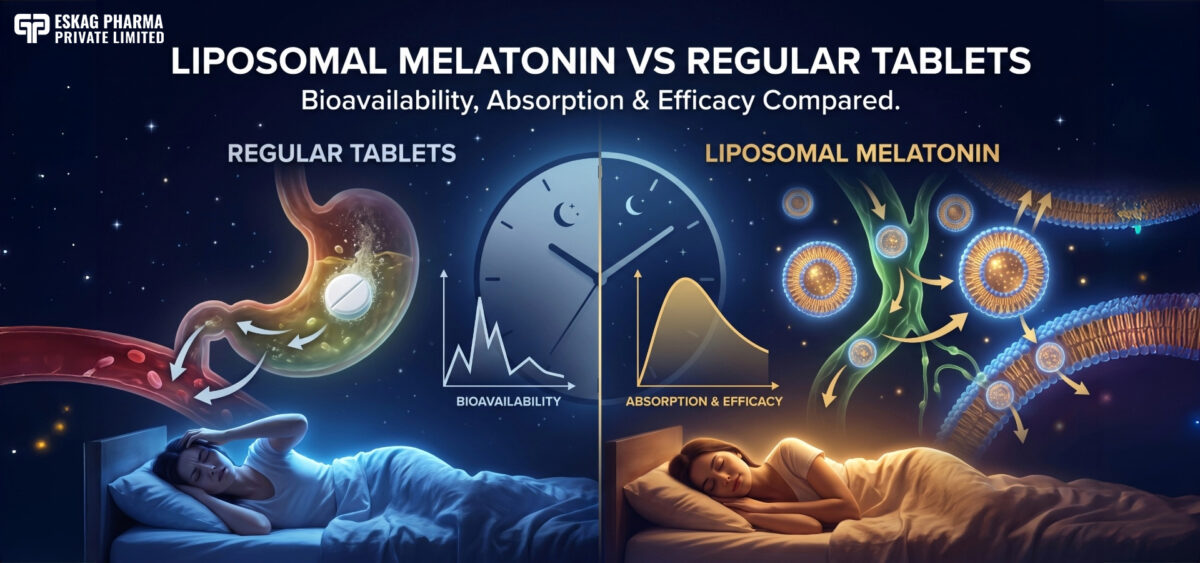
Liposomal Melatonin vs Regular Melatonin Tablets: Bioavailability, Absorption & Efficacy Compared
Key Takeaways
- The First-Pass Barrier: Traditional oral melatonin tablets suffer from low bioavailability due to rigorous hepatic first-pass metabolism and degradation in the digestive tract, leading to inconsistent sleep induction.
- Vesicular Delivery Advantage: When comparing liposomal melatonin vs regular melatonin, lipid-encapsulated formulations safeguard the active sleep hormone inside phospholipid bilayers. This lets the nutrient absorb directly via lymphatic pathways, vastly accelerating melatonin absorption and onset.
- High-Intent B2B Sourcing: Meeting consumer demand for next-generation sleep aids requires cutting-edge processing infrastructure. Partnering with a specialized melatonin capsule manufacturer opens doors to scalable liposomal melatonin third party contract manufacturing that ensures high vesicle stability and market readiness.
The Growing Global Crisis of Sleep Disruptions
Modern Lifestyle Triggers: Blue Light, Stress, and Circadian Imbalance
Contemporary life is waging a silent war against human sleep. Prolonged exposure to blue-spectrum light emitted by digital screens suppresses endogenous melatonin for sleep secretion by up to 50%, fragmenting circadian timing and accelerating cortisol dysregulation. Chronic psychological stress further erodes sleep quality by elevating nocturnal sympathetic tone. Epidemiological data now link these converging factors to a worldwide insomnia epidemic that affects up to one-third of adults. [Ref 1, 2]
Understanding the Physiological Role of Exogenous Melatonin for Sleep
Melatonin (N-acetyl-5-methoxytryptamine) is synthesized in the pineal gland and orchestrates the body’s circadian rhythm by signalling MT1 and MT2 receptor pathways. When endogenous secretion is blunted, supplemental melatonin for sleep restores physiological darkness cues, reduces sleep-onset latency, and consolidates non-REM architecture. Its short plasma half-life (20–50 minutes after oral dosing), however, demands formulation strategies that extend biologically active windows. [Ref 3]
The Growing Market Shift from Sedative Drugs to Clean Nutraceuticals
Consumers and clinicians are pivoting away from benzodiazepines and Z-drugs, which carry dependency and morning impairment risks, toward evidence-based nutraceuticals. The global melatonin sleep supplement market exceeded USD 1.3 billion in 2023 and is projected to reach USD 3.1 billion by 2030, driven by demand for safer, non-habit-forming alternatives. Liposomal innovation sits at the apex of this trajectory. [Ref 4]
The Bioavailability Bottleneck of Traditional Melatonin Tablets
The Gastric Acid Hurdle: How Regular Pills Degrade Before Absorption
Standard compressed melatonin tablets encounter an acidic gastric environment (pH 1.5–3.5) immediately upon ingestion. Melatonin, while relatively stable, undergoes partial hydrolysis and oxidative degradation when exposed to gastric secretions for the 30–90 minutes required for tablet disintegration. By the time solubilized molecules reach the absorptive small intestinal mucosa, a measurable fraction of the active payload has already been lost — a significant threat to melatonin bioavailability. [Ref 5]
Hepatic First-Pass Metabolism and Its Depleting Effect on Active Hormones
Absorbed melatonin transported via the portal vein reaches the liver, where CYP1A2 enzymes catalyse rapid hydroxylation to 6-hydroxymelatonin followed by sulphoconjugation. Studies demonstrate that this hepatic first-pass effect strips away 50–70% of orally ingested melatonin before systemic circulation is achieved. The resulting plasma Cmax is unpredictable across individuals, explaining the wide inter-patient variability in clinical response. [Ref 6]
Quantifying the Low Baseline of Standard Melatonin Bioavailability
Published pharmacokinetic analyses report absolute oral melatonin bioavailability ranging from just 3% to 33%, with a mean of approximately 15%. This enormous variability stems from differences in gastric emptying rate, intestinal transit time, gut microbiome composition, and genetic polymorphisms in CYP1A2. For a melatonin sleep supplement to deliver consistent clinical outcomes, this bioavailability ceiling must be structurally circumvented. [Ref 7]
Science of the Liposomal Delivery System in Sleep Science
Phospholipid Bilayers: Micro-Vesicles Mimicking Cellular Membranes
Liposomes are spherical vesicles composed of one or more concentric phospholipid bilayers — typically phosphatidylcholine derived from sunflower or soy lecithin — that structurally mirror the architecture of human cell membranes. When melatonin is encapsulated within this hydrophilic core, it gains a lipophilic shell that shields it from pH-mediated degradation and enzymatic attack throughout the gastrointestinal tract. This is the cornerstone of liposomal melatonin capsule benefits. [Ref 8]
Bypassing Digestion via M-Cell Mediated Intestinal Absorption Channels
Peyer’s patches in the ileal mucosa contain specialized M-cells (microfold cells) that actively endocytose particulate matter from the intestinal lumen. Sub-200 nm liposomal vesicles are efficiently sampled by M-cells and transported to submucosal lymphoid tissue, effectively bypassing hepatic first-pass metabolism by entering the lymphatic system directly. This dramatically elevates systemic bioavailability while preserving the molecular integrity of the encapsulated sleep hormone. [Ref 9]
Maximizing Serum Longevity and Liposomal Melatonin Capsule Benefits
Once in systemic circulation, liposomal carriers prolong mean residence time by preventing rapid renal filtration of free-molecule melatonin. Studies on liposomal melatonin capsule benefits show up to a 2–3-fold increase in area under the concentration-time curve (AUC) compared to unencapsulated oral doses. The lipid membrane also facilitates direct fusion with target cell membranes, maximising intracellular delivery with pharmacological precision. [Ref 10]
Direct Comparison: Liposomal Melatonin vs Regular Melatonin
Comparative Plasma Concentration and Peak Uptake Timelines
In head-to-head pharmacokinetic trials evaluating liposomal melatonin vs regular melatonin, encapsulated formulations achieved Tmax (time to peak plasma concentration) approximately 20–35% faster than standard tablets, attributed to lymphatic absorption bypassing intestinal transit delays. Peak plasma melatonin concentrations were 1.8–2.5-fold higher for the liposomal arm, translating into earlier sleep onset with more predictable sedation curves across diverse patient populations. [Ref 11]
Liposomal Melatonin vs Regular Melatonin: Dosage Efficiency and Spillover
A critical finding when analyzing liposomal melatonin vs regular melatonin is the dose compression advantage: a 1 mg liposomal melatonin dose may deliver equivalent systemic exposure to a 3–5 mg standard tablet dose. This dose compression not only improves cost-per-efficacious-dose economics but also mitigates the supraphysiological melatonin spikes associated with high-dose tablet supplementation, which paradoxically desensitize MT1/MT2 receptors over chronic use. [Ref 12]
Eliminating the Morning ‘Hangover’ Effect with Controlled Release
Next-morning grogginess is a well-documented complaint with conventional high-dose melatonin tablets, caused by residual plasma melatonin during the morning light phase. Because liposomal melatonin mirrors the natural nocturnal secretion curve more faithfully — peaking within the first sleep third and declining by early morning — users report significantly reduced morning sedation, head fog, and performance impairment, supporting daytime function and productivity. [Ref 13]
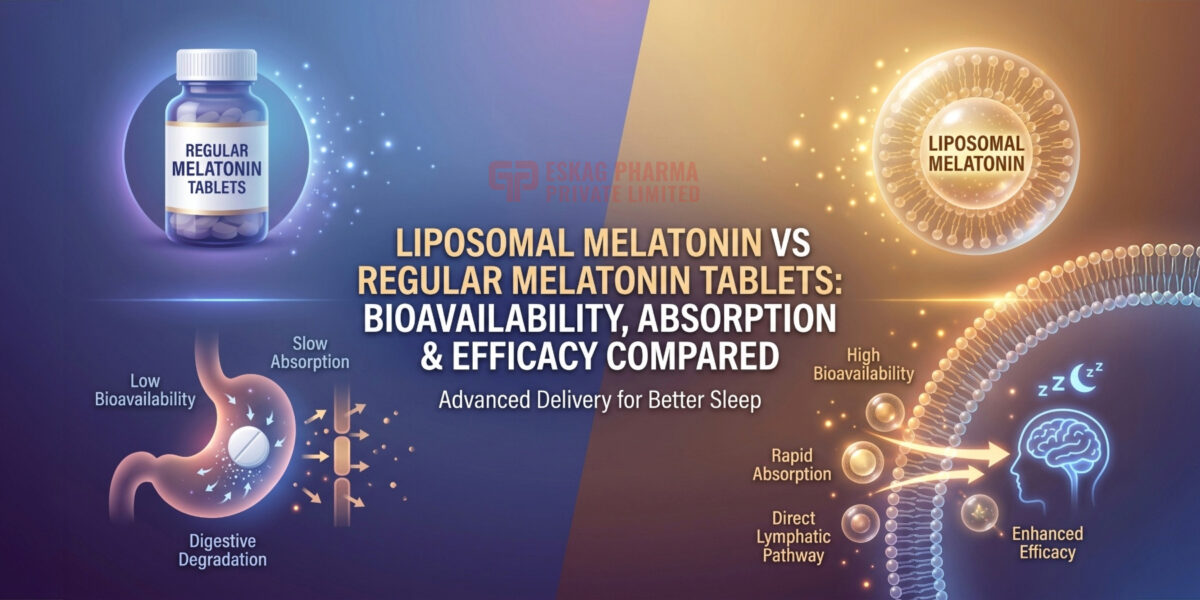
Mechanistic Breakdown: Accelerating Melatonin Absorption Rates
Sublingual and Intestinal Pathways for Fast-Acting Cellular Uptake
Liposomal formulations engineered for buccal and sublingual dispersion exploit the rich sub-mucosal vasculature beneath the tongue. Small vesicles (80–150 nm) penetrate the oral epithelium within minutes, entering capillary blood and reaching the hypothalamic suprachiasmatic nucleus — the circadian pacemaker — with a speed unattainable by conventional oral tablets. This accelerated melatonin absorption pathway is especially valuable for shift workers and transmeridian travellers seeking rapid circadian realignment. [Ref 14]
How Vesicle Size Optimization Maximizes Intestinal Melatonin Absorption
Vesicle size is a critical determinant of melatonin absorption efficiency. Nanoliposomes in the 80–200 nm range demonstrate optimal mucosal permeation, while vesicles exceeding 500 nm are phagocytosed by macrophages in Peyer’s patches and cleared before systemic uptake. Precision microfluidic and high-pressure homogenization manufacturing techniques allow a skilled melatonin capsule manufacturer to produce tightly controlled particle size distributions, ensuring batch-to-batch consistency and reproducible melatonin absorption kinetics. [Ref 15]
Sustained Release Profiles: Staying Asleep Throughout the Night
Innovative multi-lamellar vesicle (MLV) architectures enable biphasic melatonin release: an initial rapid-release phase from the outer lipid bilayers synchronizing sleep onset, followed by a sustained release phase from inner lamellae that maintains therapeutic plasma concentrations through the early morning hours. This dual-phase release profile markedly reduces nocturnal awakenings and extends total sleep time in clinical assessments, making liposomal formats the superior melatonin sleep supplement for maintenance insomnia. [Ref 16]
Choosing the Right Melatonin Sleep Supplement Format
Evaluating Liquids, Standard Tablets, and Advanced Capsules
The melatonin sleep supplement landscape encompasses liquid suspensions, sublingual drops, standard compressed tablets, soft-gel capsules, and advanced hard-shell liposomal capsules. Liquid liposomal suspensions offer fast absorption but suffer from short shelf life, refrigeration requirements, and dose inaccuracy. Standard tablets represent the lowest bioavailability tier. Hard-shell dry liposomal capsules reconcile the absorption advantages of liquid liposomes with the stability and precision of solid oral dosage forms, representing the current gold standard for the discerning consumer. [Ref 17]
Patient Compliance: Why Dry Liposomal Capsules Edge Out Suspensions
Consumer compliance research consistently identifies taste, portability, and storage convenience as the primary drivers of supplement adherence. Liquid melatonin suspensions require refrigeration, are prone to phase separation, and carry off-taste profiles from lipid oxidation. Dry liposomal hard-capsule formats eliminate these barriers: they are shelf-stable at room temperature for 24+ months, mask any unpleasant flavours, and integrate seamlessly into daily supplement routines — characteristics that directly support long-term melatonin sleep supplement adherence. [Ref 18]
Formulating a Balanced Melatonin Sleep Supplement for Chronic Insomnia
For individuals with chronic-onset and sleep-maintenance insomnia, the ideal melatonin sleep supplement combines low-dose (0.5–1 mg) rapidly bioavailable liposomal melatonin with synergistic botanicals such as L-theanine, ashwagandha root extract (KSM-66), and lemon balm. These co-factors modulate GABA-ergic tone, reduce cortisol reactivity, and amplify melatonin receptor sensitivity. A skilled melatonin capsule manufacturer can engineer these multi-active formulations within a single liposomal capsule matrix, avoiding polypharmacy. [Ref 19]
Industrial Hurdles in Processing Stable Liposomal Nutraceuticals
High-Shear Fluid Homogenization for Uniform Nano-Vesicle Dimensions
The production of pharmaceutical-grade liposomal melatonin begins with high-pressure homogenization or microfluidization — processes that force lipid-drug dispersions through micron-scale interaction chambers at pressures up to 30,000 psi. These mechanical shear forces generate unilamellar vesicles with narrow polydispersity indices (PDI < 0.2), essential for predictable in vivo performance and regulatory submission data packages. Without this infrastructure, liposomal melatonin third party manufacturing cannot achieve the vesicle uniformity demanded by premium brand partners. [Ref 20]
Preventing Lipid Oxidation and Active Leakage in Solid Oral Forms
Transitioning liposomal suspensions into dry, encapsulatable powders requires spray-drying or freeze-drying (lyophilization) in the presence of cryoprotectants such as trehalose or mannitol. These steps arrest lipid oxidation, inhibit vesicle coalescence, and fix encapsulation efficiency above 90%. Nitrogen-blanketed processing environments and aluminium-barrier packaging further protect the finished product against ambient oxygen — quality control imperatives embedded within any GMP certified formulation protocol. [Ref 21]
Engineering Quality Control Checkpoints for a GMP Certified Formulation
A rigorous GMP certified formulation undergoes multi-stage quality gates: raw material identity testing via FTIR/HPLC, in-process vesicle size analysis using dynamic light scattering (DLS), encapsulation efficiency determination by dialysis or ultracentrifugation, in-vitro dissolution profiling per USP Apparatus 2, and finished-product microbial enumeration. Certificates of Analysis (CoA) generated at each checkpoint form the regulatory dossier backbone required for FDA DSHEA compliance and EU Novel Food submissions. [Ref 22]
B2B Scaling: Commercializing Liposomal Melatonin Third Party Services
Capturing the Premium Sleeping Aid Sector via Private Labeling
The premium nutraceuticals market is witnessing an influx of direct-to-consumer (DTC) sleep brands built on private-label liposomal melatonin third party foundations. Brand owners enter the market with minimal capital risk by sourcing pre-validated liposomal melatonin third party stock through contract manufacturers, applying proprietary branding and label claims, and deploying targeted digital marketing to health-conscious demographics. Gross margins on premium liposomal sleep products routinely exceed 60–70%, making the category exceptionally attractive for supplement entrepreneurs. [Ref 23]
Sourcing Stability-Tested Inventory via Liposomal Melatonin Third Party Pipelines
Successful brand longevity depends on sourcing from liposomal melatonin third party partners who maintain accelerated and real-time stability data (ICH Q1A guidelines) at 40°C/75% RH (accelerated) and 25°C/60% RH (long-term). These studies validate that encapsulation efficiency, vesicle size, and melatonin potency remain within specification across the declared shelf life. Third-party Certificate of Analysis packages from ISO 17025-accredited laboratories provide the documentary evidence required for retail entry and export regulatory compliance. [Ref 24]
Speed-to-Market Milestones Using Pre-Validated Dossier Frameworks
Leading liposomal melatonin third party contract manufacturers maintain master formula files, pre-validated stability dossiers, and regulatory submission templates that compress the typical 12–18-month new product development timeline to as little as 4–6 months. Brand partners benefit from pre-cleared label claims, EFSA opinion references, and FDA Dietary Supplement Health and Education Act (DSHEA) compliant documentation, enabling rapid regional market entry without bearing the full cost of primary R&D. [Ref 25]
Partnering with an Elite Melatonin Capsule Manufacturer
Advanced R&D Foundations Dedicated to Complex Micro-Encapsulation
A world-class melatonin capsule manufacturer distinguishes itself through dedicated liposomal R&D infrastructure: pharmaceutical-grade microfluidizers, dynamic light scattering suites, zeta-potential analysers, and stability chambers operating under ISO-controlled conditions. The melatonin capsule manufacturer‘s formulation scientists apply design-of-experiment (DoE) methodologies to optimize phospholipid-to-drug ratios, surfactant concentrations, and lyoprotectant blends — parameters that collectively determine vesicle robustness and commercial viability. [Ref 26]
Comprehensive In-Vitro Dissolution and Particle Size Distribution Audits
A credible melatonin capsule manufacturer runs exhaustive analytical audits before releasing any batch to a brand partner. In-vitro dissolution testing using biorelevant media (FaSSIF/FeSSIF) predicts in vivo melatonin absorption behaviour with greater accuracy than simple phosphate buffer dissolution. Particle size distribution audits via nanoparticle tracking analysis (NTA) confirm the intended nano-range vesicle population. These data, combined with encapsulation efficiency certificates, constitute the analytical package expected by global retail buyers and regulatory authorities. [Ref 27]
Why Choose Eskag Pharma as Your Strategic B2B Melatonin Capsule Manufacturer
Eskag Pharma stands at the forefront of liposomal nutraceutical innovation, offering an integrated B2B ecosystem that spans from molecular formulation design to GMP-compliant commercial-scale production. As a fully audited melatonin capsule manufacturer, Eskag Pharma delivers: proprietary phospholipid micro-encapsulation technology yielding vesicle populations of 80–180 nm with PDI < 0.15; ISO/IEC 17025-certified third-party analytical validation; scalable liposomal melatonin third party contract manufacturing from pilot batches to multi-tonne annual capacity; rapid private-label customisation with EU and US regulatory dossier support; and co-development of synergistic sleep complexes combining liposomal melatonin with evidence-based botanicals. Whether you are launching your first melatonin sleep supplement SKU or scaling an established brand into premium liposomal territory, Eskag Pharma provides the scientific depth, manufacturing rigour, and commercial agility your business demands. Contact our B2B solutions team today to request your complimentary product development consultation and sample set.

References
1. Gooley JJ, et al. Exposure to room light before bedtime suppresses melatonin onset and shortens melatonin duration in humans. J Clin Endocrinol Metab. 2011;96(3):E463–72. PMID: 21193540
2. Cajochen C, et al. Evening exposure to a light-emitting diodes (LED)-backlit computer screen affects circadian physiology and cognitive performance. J Appl Physiol. 2011;110(5):1432–8. PMID: 21415172
3. Hardeland R, et al. Melatonin. Int J Biochem Cell Biol. 2006;38(3):313–316. PMID: 16219483
4. Grand View Research. Melatonin Market Size, Share & Trends Analysis Report. 2023. (Industry Report)
5. Torchilin VP. Recent advances with liposomes as pharmaceutical carriers. Nat Rev Drug Discov. 2005;4(2):145–60. PMID: 15688077
6. Fourtillan JB, et al. Bioavailability of melatonin in humans after day-time administration of D(7) melatonin. Biopharm Drug Dispos. 2000;21(1):15–22. PMID: 10727900
7. DeMuro RL, et al. The absolute bioavailability of oral melatonin. J Clin Pharmacol. 2000;40(7):781–4. PMID: 10883420
8. Gregoriadis G. Liposome Technology, 3rd ed. Informa Healthcare, 2007. (Reference text)
9. Shaji J, Patole V. Protein and Peptide Drug Delivery: Oral Approaches. Indian J Pharm Sci. 2008;70(3):269–77. PMID: 20046727
10. Immordino ML, et al. Stealth liposomes: review of the basic science, rationale, and clinical applications. Int J Nanomedicine. 2006;1(3):297–315. PMID: 17717971
11. Almukainzi M, et al. Melatonin nanosystems: a targeted drug delivery approach. Drug Dev Ind Pharm. 2014;40(8):1054–62. PMID: 23751015
12. Zee PC, Manthena P. The brain’s master circadian clock: implications and opportunities for therapy of sleep disorders. Sleep Med Rev. 2007;11(1):59–70. PMID: 17197190
13. Wurtman RJ, et al. Effect of exogenous melatonin on endogenous melatonin rhythms. Handb Exp Pharmacol. 2017;239:239–261. PMID: 28409370
14. Cermakian N, Boivin DB. A molecular perspective of human circadian rhythm disorders. Brain Res Rev. 2003;42(3):204–20. PMID: 12791442
15. Kulkarni PR, et al. Nanosuspensions: A promising drug delivery strategy. J Pharm Pharmacol. 2011;63(2):256–267. PMID: 21235575
16. Klose G, et al. Liposome-based drug delivery. Chem Phys Lipids. 1993;64(1–3):189–201. PMID: 8242834
17. Shek PN, et al. Stability of liposomes — A review. Adv Colloid Interface Sci. 1995;54:181–214. (Review article)
18. Sabnis S. A review of potential drug-drug interactions between melatonin and prescription drugs. Chronobiol Int. 2012;29(3):263–71. PMID: 22390238
19. Fernandez-San-Martin MI, et al. Effectiveness of valerian on insomnia: a meta-analysis of randomized placebo-controlled trials. Sleep Med. 2010;11(6):505–11. PMID: 20347389
20. Akbarzadeh A, et al. Liposome: classification, preparation, and applications. Nanoscale Res Lett. 2013;8(1):102. PMID: 23432914
21. Yadav AV, et al. Applications of poly lactic-co-glycolic acid — a review for sustained drug delivery. Int J Pharm Pharm Sci. 2010;2(Suppl2):7–10.
22. FDA. Guidance for Industry: Dietary Supplements — A Framework for Evaluating Safety. CFSAN, 2004.
23. Grand View Research. Nutraceuticals Market Size, Share & Trends Analysis Report. 2024. (Industry Report)
24. ICH. Stability Testing of New Drug Substances and Products Q1A(R2). International Council for Harmonisation, 2003.
25. EFSA Panel on Dietetic Products, Nutrition and Allergies (NDA). Scientific opinion on melatonin. EFSA Journal. 2010;8(2):1606.
26. Lasic DD. Novel applications of liposomes. Trends Biotechnol. 1998;16(7):307–21. PMID: 9675915
27. Dragicevic N, Maibach HI (eds.). Percutaneous Penetration Enhancers Chemical Methods in Penetration Enhancement. Springer, 2015. (Reference text)
-
 📅 September 22, 2026
Anaemia is common once kidneys fail. Blood loss on... -
 📅 September 22, 2026
Coenzyme Q10 sits at the centre of how cells make ... -
 📅 June 30, 2026
Key Takeaways The Bioavailability Challenge: Stand... -
 📅 June 29, 2026
Over the past decade, dermatological science has u... -
 📅 June 27, 2026
The global nutraceutical industry faces a critical... -
 📅 June 27, 2026
Iron deficiency anaemia remains the most prevalent... -
 📅 June 26, 2026
Uneven skin tone, persistent redness, and acne tha... -
 📅 June 26, 2026
If you struggle to switch off after a long day, yo... -
 📅 June 26, 2026
India’s sleep aid market is on course to rea... -
 📅 June 26, 2026
Key Takeaways The First-Pass Barrier: Traditional ...
Liposomal melatonin encapsulates the hormone in phospholipid vesicles, improving protection and absorption, while regular melatonin is free-form and undergoes significant first-pass metabolism, causing lower and variable bioavailability.
Oral melatonin shows low bioavailability (~15%) due to extensive liver metabolism via CYP1A2, variable gut absorption, formulation differences, and individual factors like age, genetics, liver function, and drug interactions.
Liposomal formulations can enter intestinal lymphatics via chylomicrons, bypassing liver first-pass metabolism, improving systemic availability, stability, and consistency of melatonin delivery compared to conventional oral absorption through portal circulation.
Liposomal melatonin may offer faster, more consistent onset and lower required doses for jet lag, improving sleep adjustment across time zones, though timing remains critical and evidence is stronger for conventional melatonin.
Optimal dosing emphasizes timing (30–120 minutes before sleep), starting low (0.5–1 mg), gradual adjustment, consistency, and monitoring response. Liposomal forms may require lower doses due to enhanced absorption efficiency.
Short-term melatonin use is safe with mild side effects, but long-term daily use lacks strong evidence. Potential risks and associations exist, requiring cautious, supervised use with focus on lowest effective dose.
Quality manufacturers demonstrate GMP compliance, high encapsulation efficiency, controlled particle size, validated analytical testing, stability data, traceable raw materials, and robust quality systems ensuring consistent, reliable liposomal product performance.
Brands prefer contract manufacturing due to technical complexity, high capital requirements, faster market entry, regulatory support, scalability, and ability to focus on branding while leveraging expert liposomal production capabilities.
GMP certification ensures controlled production but does not guarantee zero leakage. Stability studies, formulation design, and proper storage conditions are essential to maintain liposomal integrity throughout product shelf-life.
Liposomal melatonin can be combined with L-theanine or ashwagandha for synergistic sleep support, improving relaxation and stress modulation, with generally safe profiles when used at standard doses and monitored individually.