
Liposomal vs. Traditional Serums: Why Encapsulation is the Future of Dermatological Formulations
The skincare industry is changing rapidly as new technologies reshape how products work on the skin. For many years, traditional formulations dominated the market, but today advanced delivery systems are transforming the way active ingredients are applied and absorbed. One of the most promising innovations is liposomal encapsulation.
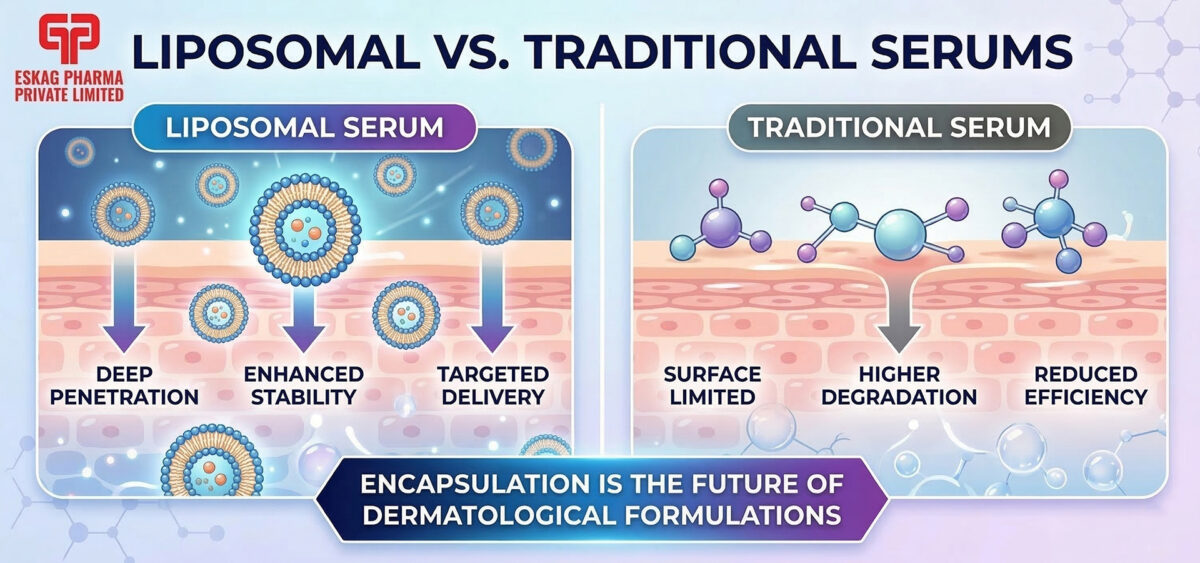
When discussing Liposomal vs traditional serum, the biggest difference lies in how active ingredients reach the deeper layers of the skin. Traditional serums often remain on the surface or struggle to pass through the skin barrier. Liposomal systems, on the other hand, are specifically designed to carry ingredients deeper into the skin while protecting them from degradation.
Encapsulation technologies—especially liposomes—are revolutionizing skincare by improving ingredient stability, enabling targeted delivery, and allowing actives to release gradually over time. These advancements are particularly important for dermatological products that address issues like aging, pigmentation, hydration, and skin sensitivity.
In this blog, we’ll explore the science behind Liposomal vs traditional serum and explain how encapsulation technology is transforming modern cosmetic and dermatological formulations.
The Evolution of Topical Delivery: Liposomal vs Traditional Serum
Skincare formulations have evolved significantly over the past few decades. Earlier products were designed mainly to apply active ingredients on the surface of the skin. While these formulations offered basic benefits, researchers eventually realized that many ingredients needed to reach deeper layers of the skin to deliver meaningful results.
The comparison between Liposomal vs traditional serum clearly shows how modern technology is improving the effectiveness of skincare products.
Understanding the Limitations of Traditional Face Serum Formulation
A typical face serum formulation contains water-based or oil-based solutions enriched with ingredients such as vitamins, peptides, botanical extracts, and antioxidants. These serums can hydrate and nourish the skin, but they also have several limitations.
One of the biggest challenges is the skin’s natural defense system—the stratum corneum. This outer layer acts as a protective shield that prevents harmful substances from entering the body. However, it also blocks many beneficial ingredients from penetrating deeper into the skin.
Because of this barrier, many actives in traditional serums stay on the skin’s surface instead of reaching the cells where they are most effective.
When comparing Liposomal vs traditional serum, conventional formulations often face several problems:
- Limited penetration into deeper skin layers
- Degradation of sensitive ingredients such as vitamin C or retinol
- Reduced stability due to exposure to air, light, and environmental factors
- Increased risk of irritation when strong ingredients are applied directly
Another issue with traditional face serum formulation is ingredient stability. Many dermatological actives are sensitive to light, oxygen, or temperature changes. When these ingredients degrade, their effectiveness decreases significantly.
As skincare science advances and consumer expectations grow, there is increasing demand for more advanced delivery systems that can overcome these limitations.
How Liposomal Skincare Technology Bridges the Gap
Liposomal skincare technology provides a modern solution to the challenges faced by traditional formulations. Liposomes are extremely small spherical structures made from phospholipid bilayers—the same type of molecules that form human cell membranes.
Because liposomes resemble natural cell membranes, they interact easily with the skin’s lipid layers. This allows them to move through the skin barrier more efficiently and deliver active ingredients deeper into the skin.
Another advantage is their versatility. Liposomes can carry both water-soluble and oil-soluble ingredients, making them ideal for advanced Liposomal serum formulation.
In the Liposomal vs traditional serum comparison, liposomal systems provide several clear advantages:
- Better penetration into the skin
- Greater stability for sensitive ingredients
- Controlled release of active compounds
- Higher bioavailability of active ingredients
Liposomes also protect ingredients from oxidation and environmental damage. By enclosing actives inside protective lipid layers, the formulation ensures that the ingredients remain stable until they reach their target location within the skin.
This innovation allows dermatological formulations to achieve stronger results even with lower concentrations of active ingredients.
Why Modern Dermatology is Moving Toward Encapsulation
Encapsulation technology is quickly becoming a key component of next-generation skincare formulations. Dermatologists and cosmetic scientists now understand that powerful ingredients alone are not enough—the way those ingredients are delivered is equally important.
The shift from Liposomal vs traditional serum reflects a larger transformation in dermatological science. Modern formulations focus on improving how ingredients interact with the skin.
Today’s skincare technologies emphasize:
- Targeted delivery of active ingredients
- Controlled and sustained release mechanisms
- Reduced irritation for sensitive skin
- Greater stability of delicate compounds
Liposomes are especially valuable because they are biocompatible and biodegradable. Their structure closely resembles natural biological membranes, allowing them to integrate smoothly with the skin.
Because of these properties, encapsulation technology represents a major step forward in the development of more effective dermatological products.
Key Differences in Liposomal Serum Formulation
Understanding the differences between Liposomal vs traditional serum is essential for brands, formulators, and skincare professionals who want to develop high-performance products.
The Role of Phospholipid Bilayers in Deep Penetration
The most important feature of Liposomal serum formulation is its phospholipid bilayer structure. These layers form tiny spherical vesicles that hold active ingredients inside their core.
Phospholipids naturally occur in human cell membranes. When they are used to create liposomal vesicles, they form structures that can merge easily with skin cells.
This unique ability allows liposomes to carry active ingredients through the stratum corneum and into deeper layers of the skin.
Compared to a traditional face serum formulation, liposomal delivery systems significantly improve ingredient absorption.
In the Liposomal vs traditional serum discussion, liposomes act as highly efficient carriers that transport beneficial molecules directly to their target cells.
Stability Comparison: Traditional vs Liposomal Skin Serum Formulation
Another major difference between traditional and liposomal formulations is ingredient stability.
Many popular skincare ingredients—including vitamin C, retinol, and peptides—are extremely sensitive to air, light, and heat. In conventional serums, these ingredients often break down before they can provide their full benefits.
However, Liposomal skin serum formulation protects these ingredients by encapsulating them within lipid membranes.
This protective layer prevents premature degradation and keeps the ingredients stable for longer periods. As a result, liposomal serums often maintain their potency throughout the product’s shelf life.
In the Liposomal vs traditional serum comparison, liposomal formulations frequently show better stability and overall performance.
Protecting Active Ingredients from Oxidation and Degradation
One of the biggest advantages of Liposomal serum formulation is its ability to shield sensitive ingredients from environmental damage.
Encapsulation protects actives from factors such as:
- UV exposure
- oxygen
- moisture
- temperature changes
This protection helps preserve ingredient effectiveness for a longer time.
In traditional face serum formulation, antioxidants and vitamins can lose their potency quickly after exposure to environmental elements. Liposomal encapsulation helps prevent this issue by keeping ingredients protected until they reach their target cells.
Significant Liposomal Serum Benefits for Modern Skin Concerns
Today’s skincare consumers expect products that deliver visible, long-lasting results. This growing demand has increased interest in the many liposomal serum benefits offered by advanced encapsulation technology.
Targeted Delivery to Deeper Epidermal Layers
One of the most important liposomal serum benefits is targeted ingredient delivery.
Liposomes can pass through the skin barrier and carry active compounds directly to specific layers of the epidermis. This targeted approach increases the effectiveness of ingredients such as:
- hyaluronic acid
- peptides
- antioxidants
- brightening agents
Compared with traditional delivery methods in the Liposomal vs traditional serum comparison, liposomal systems allow significantly better absorption.
Reduced Skin Irritation and Enhanced Biocompatibility
Another key advantage among liposomal serum benefits is improved skin compatibility.
Liposomes release active ingredients gradually, rather than exposing the skin to high concentrations all at once. This slow release helps minimize irritation and reduces the risk of redness or sensitivity.
Because liposomes closely resemble the skin’s natural structure, they are generally well tolerated by most skin types.
For this reason, liposomal serums are often recommended for people with sensitive or reactive skin.
Sustained Release Mechanisms for Long-Lasting Results
Sustained release is another major component of liposomal serum benefits.
Instead of delivering active ingredients immediately, liposomes release them slowly over time. This continuous delivery allows ingredients to work for longer periods and improves overall treatment effectiveness.
In the ongoing Liposomal vs traditional serum comparison, this sustained release mechanism is one of the biggest advantages of liposomal formulations.
Science of Brightening: Liposomal Skin Whitening Serum Formulation
Skin brightening and pigmentation correction remain some of the most common skincare goals worldwide. Uneven skin tone, dark spots, and hyperpigmentation are concerns that many consumers try to address through serums and dermatological treatments. However, traditional brightening formulations often struggle with ingredient stability and absorption.
This is where advanced encapsulation technologies make a major difference. A Liposomal skin whitening serum formulation enhances the performance of brightening ingredients by protecting them and delivering them more effectively to the skin.
How Encapsulation Improves the Efficacy of Brightening Agents
In a Liposomal skin whitening serum formulation, powerful brightening ingredients such as vitamin C, kojic acid, and niacinamide are encapsulated within microscopic liposomes.
This protective encapsulation helps deliver these ingredients directly to melanocytes—the skin cells responsible for producing melanin. By targeting these cells more efficiently, liposomal systems can significantly improve the effectiveness of pigmentation treatments.
When comparing Liposomal vs traditional serum, liposomal formulations typically provide better ingredient stability and deeper skin penetration. As a result, the brightening agents remain active for longer and can produce more visible improvements in skin tone.
Overcoming Solubility Issues in Traditional Brightening Serums
Many brightening ingredients are difficult to formulate because they are unstable or poorly soluble in conventional solutions.
For example:
- Vitamin C oxidizes quickly when exposed to air or light
- Kojic acid can degrade in water-based formulations
- Arbutin requires stable conditions to maintain its effectiveness
These challenges often reduce the performance of traditional brightening products.
A Liposomal skin whitening serum formulation solves these problems by enclosing active ingredients within lipid vesicles. This protective environment shields the ingredients from external factors and improves their stability.
As a result, the formulation can maintain ingredient potency throughout the product’s shelf life while delivering more consistent results.
Achieving Uniform Skin Tone with Advanced Liposomal Skin Serum Formulation
The ultimate goal of any Liposomal skin serum formulation designed for brightening is to create a more even and radiant skin tone.
By protecting ingredients and delivering them directly to target cells, liposomal systems help maximize the effectiveness of brightening agents. This leads to better control of pigmentation and more noticeable improvements in overall skin clarity.
Because of these advantages, many skincare brands and dermatologists are increasingly favoring Liposomal vs traditional serum technologies for advanced pigmentation treatments.
Overcoming Absorption Barriers in Standard Skincare
One of the biggest challenges in skincare formulation is overcoming the skin’s natural barrier system.
While the skin barrier is essential for protecting the body from environmental damage, it also makes it difficult for beneficial ingredients to penetrate deeply.
The Challenge of the Stratum Corneum Barrier
The stratum corneum is the outermost layer of the skin and acts as a protective shield against pollutants, bacteria, and harmful substances.
Although this barrier is essential for maintaining healthy skin, it also prevents many active ingredients from reaching deeper layers where they can deliver the most benefit.
In a Liposomal vs traditional serum comparison, traditional formulations often struggle to pass through this barrier. As a result, many active compounds remain on the surface of the skin instead of reaching their target cells.
This limitation is one of the primary reasons why advanced delivery systems are becoming increasingly important in skincare science.
How Liposomes Act as “Trojan Horses” for Active Ingredients
Liposomes function as tiny delivery vehicles that transport active ingredients across the skin barrier.
Their lipid structure is very similar to the natural lipids found in human skin. Because of this similarity, liposomes can merge with the skin’s lipid layers and release their encapsulated ingredients into deeper tissues.
This process is often described as a “Trojan Horse” delivery system. Liposomes carry the active ingredients through the skin barrier without triggering the skin’s defensive mechanisms.
In the Liposomal vs traditional serum discussion, this ability to bypass the skin barrier is one of the key reasons liposomal systems are considered more effective.
Bioavailability Metrics: Liposomal vs Traditional Serum
Bioavailability refers to the amount of an active ingredient that actually reaches its intended target within the body or skin.
In skincare formulations, higher bioavailability means that more of the ingredient is absorbed and utilized by the skin cells.
When comparing Liposomal vs traditional serum, liposomal formulations often show significantly higher bioavailability. Because liposomes protect and transport ingredients more efficiently, a larger portion of the active compounds reaches the target site.
This improved delivery means that lower concentrations of ingredients can still produce strong and effective results.
Technical Challenges in Manufacturing Liposomal Serums
Although liposomal technology offers many advantages, producing high-quality liposomal formulations requires specialized equipment, expertise, and strict quality control.
Developing stable liposomal products is more complex than manufacturing traditional serums.
Maintaining Vesicle Size and Uniformity
One of the most important aspects of Liposomal serum formulation is controlling the size of the liposomes.
For effective skin penetration, liposomes must be small enough to pass through the skin barrier but large enough to remain structurally stable.
Achieving consistent vesicle size requires advanced manufacturing techniques such as high-pressure homogenization and microfluidization. These processes ensure that the liposomes remain uniform throughout the formulation.
Maintaining this uniformity is essential for ensuring consistent product performance.
Ensuring Long-Term Stability in Liquid Formulations
Another major challenge in liposomal manufacturing is maintaining long-term stability.
Liposomal vesicles can break down, fuse together, or degrade if the formulation conditions are not carefully controlled. Factors such as temperature, pH levels, and storage conditions all affect the stability of the product.
To maintain stability, formulators must carefully select the right phospholipids, stabilizers, and packaging systems. Advanced emulsification technologies also play an important role in preserving the integrity of liposomal formulations.
Quality Control Standards in a Professional Face Serum Manufacturer Facility
A professional face serum manufacturer must follow strict quality control procedures when producing liposomal products.
These quality checks typically include:
- particle size measurement
- encapsulation efficiency testing
- stability analysis
- microbiological safety testing
These tests ensure that the formulation remains safe, stable, and effective throughout its shelf life.
Only experienced manufacturers with advanced research and development capabilities can produce high-quality liposomal serums on a commercial scale.
The Commercial Shift: Why Brands Are Choosing Liposomal Technology
The rise of liposomal formulations is not driven only by scientific innovation—it is also influenced by growing market demand.
Consumers are increasingly interested in advanced skincare technologies that deliver visible results.
Rising Consumer Demand for High-Tech Cosmeceuticals
Modern consumers are becoming more informed about skincare ingredients and formulation technologies. Many now look for products that combine dermatological science with proven effectiveness.
The discussion around Liposomal vs traditional serum has become a central part of this trend toward science-backed skincare.
People want products that go beyond basic skincare and offer measurable improvements in skin health and appearance.
Differentiation in a Crowded Skincare Market
The global skincare market is extremely competitive, with thousands of brands offering similar products.
To stand out, companies must offer something unique. Liposomal delivery systems provide an innovative way for brands to differentiate their products.
By incorporating Liposomal skincare technology, companies can create high-performance formulations that appeal to consumers seeking advanced solutions.
This technological advantage can help brands position their products as premium cosmeceuticals.
Future Trends in Liposomal Cosmetic Manufacturer Strategies
For a Liposomal cosmetic manufacturer, the future lies in developing even more advanced encapsulation technologies.
Some emerging trends in the industry include:
- multi-layer liposomal vesicles
- targeted nano-delivery systems
- hybrid lipid-based carriers
- AI-assisted formulation research
These innovations are expected to further enhance the effectiveness of dermatological formulations and expand the possibilities for skincare treatments.
Why Choose Eskag Pharma as Your Manufacturing Partner?
Selecting the right manufacturing partner is crucial for skincare brands looking to develop advanced liposomal products.
An experienced manufacturer ensures that formulations are safe, stable, and compliant with international quality standards.
Expert Liposomal Serum Manufacturer with Decades of Experience
Eskag Pharma is a trusted Liposomal serum manufacturer with years of experience in dermatological and pharmaceutical formulations.
The company combines pharmaceutical-grade manufacturing practices with advanced cosmetic science to produce highly effective liposomal skincare products.
Their expertise allows brands to develop innovative formulations that meet the evolving needs of modern consumers.
Specialized Liposomal Serum Formulation Manufacturer Capabilities
As an experienced Liposomal serum formulation manufacturer, Eskag Pharma offers comprehensive development and manufacturing services.
These services include:
- customized formulation development
- advanced liposomal encapsulation technology
- stability and performance testing
- regulatory support and compliance
These capabilities help skincare brands bring innovative products to market with confidence.
WHO-GMP Certified Production for Global Export Markets
Eskag Pharma operates WHO-GMP certified manufacturing facilities that meet international pharmaceutical production standards.
This certification ensures that every liposomal formulation is produced under strict quality control conditions.
By partnering with a reliable Liposomal serum manufacturer and Liposomal cosmetic manufacturer, brands can access advanced encapsulation technology while maintaining the highest levels of safety, quality, and regulatory compliance.
Conclusion
The comparison of Liposomal vs traditional serum highlights a major shift in the science of dermatological formulations. While traditional serums still have their place in skincare routines, liposomal technology offers significant improvements in ingredient delivery, stability, and effectiveness.
With advanced Liposomal skincare technology, formulators can overcome the limitations of conventional face serum formulation systems and create products that deliver measurable results.
From improved penetration and ingredient protection to sustained release mechanisms, the many liposomal serum benefits make encapsulation one of the most exciting innovations in modern skincare.
As research and technology continue to evolve, liposomal formulations are likely to become the new standard for high-performance dermatological products—transforming how skincare solutions are developed, manufactured, and experienced by consumers worldwide.
-
 📅 June 30, 2026
Key Takeaways The Bioavailability Challenge: Stand... -
 📅 June 29, 2026
Over the past decade, dermatological science has u... -
 📅 June 27, 2026
The global nutraceutical industry faces a critical... -
 📅 June 27, 2026
Iron deficiency anaemia remains the most prevalent... -
 📅 June 26, 2026
Uneven skin tone, persistent redness, and acne tha... -
 📅 June 26, 2026
If you struggle to switch off after a long day, yo... -
 📅 June 26, 2026
India’s sleep aid market is on course to rea... -
 📅 June 26, 2026
Key Takeaways The First-Pass Barrier: Traditional ... -
 📅 June 24, 2026
Sleep disruption is not simply a lifestyle inconve... -
 📅 June 18, 2026
The sleep supplement industry is undergoing a fund...
The main difference between Liposomal vs traditional serum lies in how active ingredients are delivered into the skin. Traditional serums often sit on the surface and provide limited penetration, while liposomal serums use microscopic phospholipid vesicles to encapsulate actives. These vesicles mimic skin cell membranes and help transport ingredients deeper into the epidermis, improving absorption, stability, and overall effectiveness compared to conventional serum formulations.
Yes, liposomal serums are often considered better for sensitive skin because they release active ingredients gradually rather than delivering them all at once. This controlled delivery helps reduce irritation and redness. The phospholipid structure of liposomes is similar to the skin’s natural barrier, which improves compatibility. As a result, liposomal serums can provide effective treatment benefits while minimizing sensitivity, making them ideal for reactive or delicate skin types.
Encapsulation significantly enhances face serum formulation by protecting sensitive ingredients from oxidation, light exposure, and degradation. Liposomes act as protective carriers that surround active compounds, allowing them to remain stable until they reach the skin’s deeper layers. This improves ingredient potency and ensures more effective delivery. Encapsulation also allows formulators to combine ingredients that might otherwise be unstable together, resulting in more advanced and high-performing skincare products.
One of the major liposomal serum benefits for anti-aging is enhanced delivery of active ingredients such as peptides, retinol, and antioxidants into deeper skin layers. Liposomal systems improve ingredient stability and allow slow, sustained release, which supports long-term skin repair and collagen stimulation. This targeted delivery helps reduce the appearance of fine lines, wrinkles, and dullness while improving hydration and elasticity for healthier, more youthful-looking skin.
A Liposomal skin whitening serum formulation is more effective because encapsulation protects brightening agents like vitamin C, kojic acid, or Niacinamide from oxidation and instability. Liposomes deliver these ingredients directly to melanocyte cells responsible for pigment production. This targeted delivery improves ingredient penetration and efficacy. As a result, liposomal formulations can help achieve more uniform skin tone, better pigmentation control, and longer-lasting brightening results compared to traditional whitening serums.
Yes, Eskag Pharma offers contract manufacturing services for liposomal serums through its advanced formulation and production facilities. As an experienced Liposomal serum manufacturer, the company provides custom formulation development, encapsulation technology, stability testing, and regulatory support. These services allow skincare brands to develop innovative liposomal products while ensuring compliance with international manufacturing standards and maintaining high levels of quality and product consistency.
Liposomal technology can be highly stable for long-term storage when manufactured using proper formulation techniques and controlled production conditions. Stability depends on factors such as vesicle size, phospholipid composition, and packaging environment. Professional manufacturers conduct rigorous stability testing to maintain product integrity over time. When properly formulated, liposomal serums can preserve sensitive ingredients effectively and maintain their therapeutic performance throughout the product’s shelf life.
Liposomes help improve skin penetration because their phospholipid structure closely resembles the natural lipid layers of human skin. This similarity allows them to merge with the skin barrier and transport encapsulated ingredients into deeper epidermal layers. Acting like microscopic carriers, liposomes deliver active compounds directly to target cells. This mechanism significantly increases ingredient absorption compared with traditional serums that mostly remain on the skin surface.
Many active ingredients can be incorporated into a Liposomal serum formulation, including both water-soluble and fat-soluble compounds. Liposomes can encapsulate antioxidants, peptides, vitamins, botanical extracts, and brightening agents. However, the compatibility of each ingredient depends on its molecular structure, stability, and solubility. Skilled formulators evaluate these factors carefully to ensure that the encapsulation process maintains ingredient effectiveness and supports optimal delivery within the skincare formulation.
Eskag is considered a preferred Liposomal cosmetic manufacturer because of its expertise in advanced dermatological formulations and pharmaceutical-grade manufacturing standards. The company offers specialized liposomal formulation capabilities, experienced R&D teams, and WHO-GMP certified production facilities. These strengths allow Eskag to deliver high-quality, stable, and innovative liposomal skincare products for global markets, making it a trusted partner for brands seeking reliable and advanced cosmetic manufacturing solutions.