
From Rough to Remarkable: How to Make Your Skin Feel Silk-Smooth Again
Rough, tight, and uneven skin often signals disruption of the epidermal lipid matrix that maintains hydration balance. Environmental stress, over-exfoliation, and aggressive actives can gradually weaken this protective layer, resulting in visible texture changes and increased sensitivity. A scientifically designed skin barrier repair cream supports restoration by reinforcing structural lipids and reducing transepidermal water loss. Many formulations promise rapid results, yet true barrier recovery depends on evidence-based ingredient selection and delivery science.
In this blog, the focus remains on the physiology of barrier damage, formulation strategy, and manufacturing standards that influence long-term skin resilience.
Key Takeaways:
- Barrier disruption increases water loss and compromises structural lipid organisation within the stratum corneum.
- Lipid-balanced formulations improve hydration persistence and support measurable skin texture recovery.
- Delivery systems and quality-controlled manufacturing directly influence product performance and tolerability.
Why Your Skin Feels Rough and Uneven
Skin roughness often signals disrupted barrier lipids and impaired epidermal hydration balance.
Understanding a Damaged Skin Barrier
Your skin feels rough when the outermost layer, the stratum corneum, loses its structural lipids and its natural moisture balance. This layer serves as a protective shield, limiting transepidermal water loss and blocking external irritants. When its lipid matrix becomes disrupted, microcracks form, leading to dryness, tightness, and uneven texture. For brands and formulators, this highlights the importance of a scientifically designed barrier repair cream that supports lipid replenishment and restores structural integrity without overloading the skin.
Common Causes of Skin Texture Issues
Frequent exfoliation, high-strength actives, harsh cleansers, and unsuitable formulations can disrupt the skin’s lipid balance and pH. Climatic shifts, indoor air conditioning, and UV exposure further accelerate moisture depletion. In such cases, a well-formulated skin barrier repair moisturiser must combine humectants, emollients, physiologic lipids, and stabilised antioxidants, such as liposomal alpha-lipoic acid, in optimal proportions to prevent further compromise.
From a formulation standpoint, stability, compatibility, and controlled ingredient delivery are critical to ensure consistent skin texture repair.
How Environmental Stress Weakens the Skin Barrier
Pollution, particulate matter, UV radiation, and oxidative stress trigger inflammatory pathways that weaken intercellular cohesion within the epidermis. Over time, this reduces resilience and increases sensitivity, resulting in rough, reactive skin. Advanced delivery systems, such as Liposomal cream technology, can support targeted hydration and enhanced ingredient stability while reducing the potential for irritation. For skincare manufacturers, integrating delivery science with barrier-focused actives enables differentiated, performance-led formulations that address environmental stress with measurable efficacy.
Understanding the causes of barrier disruption provides context for targeted restoration strategies.
What Is a Skin Barrier Repair Cream and Why Does It Matter?
A damaged skin barrier loses water rapidly due to disrupted intercellular lipids and weakened corneocyte cohesion.
How a Skin Barrier Repair Cream Restores Moisture Balance
A regular moisturiser primarily hydrates and softens the skin’s surface layer. In contrast, a barrier repair face cream is formulated to address structural lipid deficiency and reinforce epidermal resilience. While a soft skin cream may deliver immediate smoothness, barrier-focused formulations target long-term barrier stability and reduced sensitivity. The distinction lies in lipid science, ingredient synergy, and clinically relevant performance objectives.
Barrier Repair Cream vs Regular Moisturiser
Daily exposure to UV radiation, pollutants, and cleansing agents can gradually compromise barrier strength. A skin barrier repair moisturiser functions as a preventive support system, maintaining hydration levels, reinforcing lipid organisation, and supporting antioxidant defence with liposomal vitamin C. When integrated into a routine, it helps sustain barrier integrity and reduces the risk of recurrent dryness or irritation.
Role of a Skin Barrier Repair Moisturiser in Daily Care
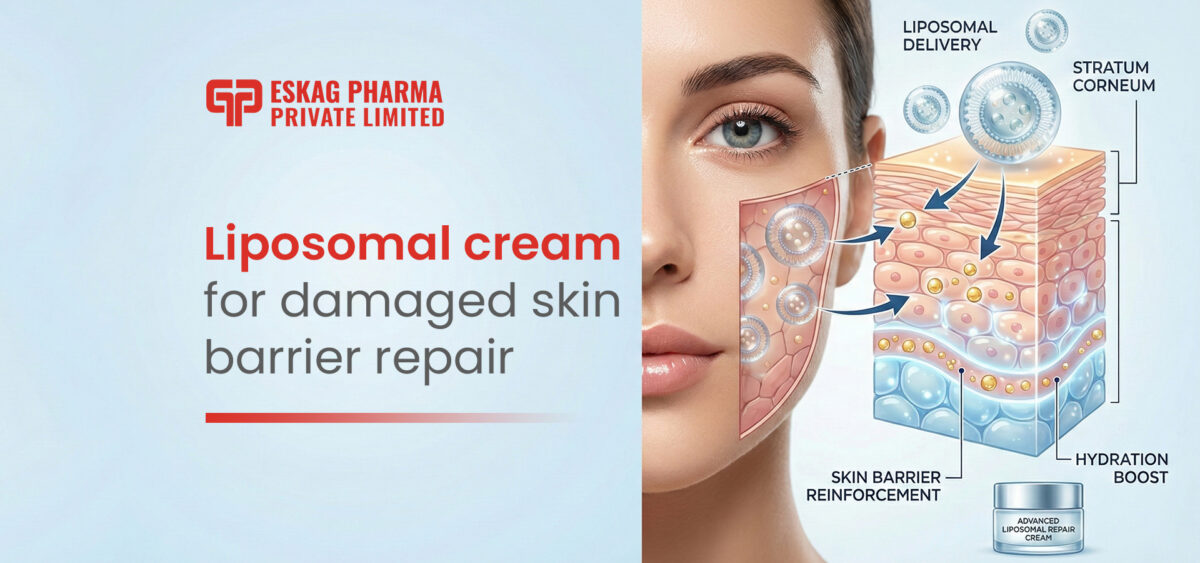
Liposomal cream technology improves ingredient stability and facilitates more uniform distribution within the epidermal layers. Encapsulation supports controlled release, which enhances hydration persistence without overwhelming sensitive skin. This approach can optimise performance in formulations designed to support compromised barriers.
As barrier science evolves, delivery technology becomes central to formulation performance.
How Liposomal Cream Enhances Skin Barrier Repair
Liposomal cream systems enhance barrier repair by improving stability, penetration efficiency, and controlled active release.
What Makes Liposomal Cream Different from Conventional Creams
Liposomal systems use phospholipid vesicles that structurally resemble biological membranes, enabling more compatible interaction with a damaged skin barrier.
- Liposomes typically range from 80 to 300 nm, allowing closer interaction with the stratum corneum than conventional emulsions [1].
- Phospholipid bilayers help encapsulate both hydrophilic and lipophilic actives within a single system.
- Encapsulation reduces direct irritant exposure, which is critical when supporting compromised skin.
- Compared to a standard formulation of moisturising cream, liposomal architecture enhances targeted delivery without excessive occlusion.
Benefits of Liposomal Cream for Deep Skin Hydration
Liposomal structures improve hydration retention by supporting the gradual diffusion of actives across superficial epidermal layers.
- A study reports up to 30% improvement in hydration retention when lipid-based carriers are optimised for dermal compatibility [2].
- Encapsulation protects moisture-binding agents such as liposomal hyaluronic acid and liposomal niacinamide from premature degradation.
- Enhanced penetration efficiency supports restoration of lipid organisation in compromised skin.
- Unlike a conventional whitening cream formulation, liposomal systems prioritise barrier reinforcement over superficial brightening claims.
Controlled Delivery for Long-Lasting Skin Texture Repair
Controlled-release mechanisms support sustained hydration and structural recovery in barrier-focused formulations.
- Liposomes provide gradual diffusion, reducing peak concentration exposure that may aggravate sensitivity.
- Sustained release improves residence time within the upper epidermal layers.
- Reduced irritation risk supports compliance in products designed for compromised skin.
- For brands seeking differentiated positioning, advanced liposomal expertise enables performance-led solutions backed by delivery science.
With delivery science established, formulation selection becomes the next critical consideration.
Choosing the Right Barrier Repair Face Cream for Smooth Skin
Choosing the right barrier repair face cream depends on lipid balance, tolerability, and long-term hydration performance.
Barrier Repair Face Cream for Sensitive and Dry Skin
Sensitive and dry skin types require formulations that reinforce lipid structure while minimising irritation potential.
- Physiological lipids such as ceramides, cholesterol, and fatty acids should be present in balanced ratios to support barrier cohesion.
- Low-irritancy emulsifiers and fragrance-free systems reduce the risk of reactivity in compromised skin.
- Controlled humectant levels prevent excessive water pull, which can worsen dryness in low-humidity climates.
- Clinical compatibility testing is essential to validate suitability for reactive or post-procedure skin.
Soft Skin Cream for Everyday Hydration
A soft skin cream designed for daily use must balance sensory appeal with barrier-supportive functionality.
- Lightweight occlusives help maintain hydration without clogging pores or causing heaviness.
- Humectants such as glycerin and sodium PCA support water retention within the stratum corneum.
- Stable emulsion systems ensure uniform distribution of actives across application cycles.
- Long-term use should enhance smoothness without disrupting natural lipid turnover.
Improving Skin Texture Repair with Consistent Use
Barrier restoration is a gradual biological process that requires structured and sustained care, supported topically and, where appropriate, alongside liposomal supplements for comprehensive skin support.
- Regular application supports reduced transepidermal water loss and improved epidermal resilience.
- Simplified routines reduce cumulative irritation from overlapping active ingredients.
- Dermatologically tested formulations increase compliance and reduce discontinuation rates.
- Measurable improvement in texture typically aligns with the natural epidermal renewal cycle.
With product selection considerations addressed, the underlying formulation science warrants closer examination.
Science Behind Liposomal Cream Formulation
Scientific formulation principles determine the stability, efficacy, and delivery performance of liposomal cream systems.
Liposomal Cream Formulation for Enhanced Penetration
Liposomal systems are designed with phospholipid bilayers that closely resemble biological membranes, thereby enabling improved interaction with the stratum corneum. Particle sizes generally range between 100–200 nm, which supports closer epidermal association compared to conventional emulsions and enhances ingredient bioavailability without increasing irritation risk. In a well-designed skin barrier repair cream, encapsulation protects sensitive actives from oxidation and premature degradation, ensuring sustained functional delivery.
Formulation of Moisturising Cream for Barrier Support
The formulation of moisturising cream intended for barrier support requires a physiologic lipid ratio that mirrors the natural 3:1:1 proportion of ceramides, cholesterol, and free fatty acids found in healthy skin. Research indicates that restoring this ratio can significantly reduce transepidermal water loss within 2–8 weeks of consistent application. When such lipid structuring is integrated into a skin barrier repair cream, it supports structural cohesion and hydration equilibrium, which is possible through liposomal cosmetics.
Whitening Cream Formulation vs Barrier Repair Cream
A whitening cream formulation typically prioritises pigment modulation pathways through agents that influence melanin synthesis, whereas a skin barrier repair cream focuses on lipid restoration and barrier resilience. Overuse of aggressive depigmenting agents can compromise barrier lipids, leading to increased sensitivity and dryness. Barrier-centric formulations instead support epidermal recovery, inflammation modulation, and hydration persistence.
Also read: Liposomal Cosmetics Explained: The Future of Targeted Skincare for Modern Brands.
How to Repair a Damaged Skin Barrier Effectively
Translating formulation science into daily practice requires a structured and disciplined recovery approach.
Step-by-Step Routine Using Skin Barrier Repair Cream
Here is a step-by-step routine to use skin barrier repair cream:
Step 1: Cleanse with a Gentle, pH-Balanced Cleanser
Use a mild, sulphate-free cleanser that preserves natural lipids and maintains physiological pH. Avoid high-foam or exfoliating cleansers that may further weaken a compromised barrier.
Step 2: Apply Skin Barrier Repair Cream on Slightly Damp Skin
Apply a skin barrier repair cream while the skin is slightly damp to improve moisture retention. This supports hydration sealing and enhances surface smoothness without excessive layering.
Step 3: Focus on Lipid Replenishment
Ensure the formulation contains ceramides, cholesterol, and fatty acids in balanced proportions. These components help reinforce structural cohesion within the stratum corneum.
Step 4: Minimise Active Ingredient Overlap
Pause high-strength acids, retinoids, and exfoliating agents during the recovery phase. Simplified routines reduce irritation and allow the epidermis to stabilise naturally.
Step 5: Protect with Daily Sun Protection
Apply a broad-spectrum sunscreen every morning to prevent UV-induced lipid degradation. Consistent protection helps sustain barrier integrity and supports long-term texture improvement.
Ingredients That Strengthen the Skin Barrier
Barrier resilience depends on ceramides, cholesterol, and essential fatty acids combined in a scientifically balanced formulation of moisturising cream. Humectants such as glycerin improve water retention, while niacinamide supports epidermal integrity. These components differ from a whitening cream formulation, which targets pigmentation rather than lipid restoration.
Preventing Future Barrier Damage
Use sunscreen daily to protect against UV-driven oxidative stress. Limit over-exfoliation and select cleansers with skin-compatible surfactants. Consistent hydration and balanced formulations help maintain long-term barrier stability without disrupting natural turnover.
Liposomal Cream vs Traditional Moisturising Creams
Comparing liposomal and traditional moisturising systems clarifies differences in delivery efficiency, stability, and barrier-focused performance.
Improved Absorption and Stability
Traditional moisturising creams rely on surface-level occlusion and emolliency, whereas liposomal systems utilise phospholipid vesicles that enhance ingredient stability and controlled epidermal interaction. Encapsulation protects sensitive actives from oxidation and degradation, improving shelf-life performance and formulation robustness.
Reduced Irritation and Enhanced Hydration
Conventional emulsions may expose active ingredients directly to compromised skin, potentially aggravating sensitivity in vulnerable users. Liposomal systems modulate release kinetics, reducing peak concentration exposure while supporting sustained hydration across superficial epidermal layers. This controlled delivery profile is particularly relevant when designing a skin barrier repair cream intended for reactive or post-procedure skin types.
Why Liposomal Cream Is Ideal for Barrier Repair
Barrier-focused formulations require both lipid replenishment and careful management of ingredient tolerability. Liposomal architecture supports compatibility with epidermal lipids while enhancing uniform dispersion of barrier-supportive actives.
Manufacturing Excellence Behind Liposomal Cream
Sustained formulation performance depends on precision manufacturing, validated processes, and stringent quality control systems.
Liposomal Cream Contract Manufacturer Expertise
Advanced liposomal cream production requires controlled phospholipid hydration, high-shear homogenisation, and particle size optimisation to achieve uniform vesicle distribution. Critical parameters, such as mean particle size (<200 nm), polydispersity index, encapsulation efficiency, and zeta potential, must be validated to ensure formulation consistency and stability.
Process standardisation, validated SOPs, and in-line monitoring systems are essential to maintain reproducibility across commercial batches. Robust scale-up capability from pilot to industrial volumes ensures uniform vesicle integrity without compromising bio-performance characteristics.
Third-Party Manufacturing of Liposomal Cream
Third-party manufacturing requires technical flexibility to customise lipid composition, active loading, and release profiles in line with brand specifications. Contract production facilities must support technology transfer documentation, master batch record development, and compatibility studies with primary packaging components.
Stability studies under accelerated and real-time conditions are required to evaluate vesicle integrity, phase separation risk, and active retention. Scalable infrastructure, including vacuum emulsification systems and controlled-temperature processing, ensures batch-to-batch consistency in GMP-aligned environments.
Quality Control and Regulatory Compliance in Liposomal Cream Production
Quality control protocols extend beyond routine microbiological and physicochemical testing to include particle size distribution analysis, quantification of encapsulation efficiency, and oxidative stability assessment. Validation of preservative efficacy, heavy metal limits, and microbial load must comply with applicable cosmetic regulatory frameworks and international safety standards.
Comprehensive documentation, including Certificate of Analysis, Safety Data Sheets, and stability dossiers, supports regulatory submissions and export readiness for a global audience. Integrated quality management systems ensure traceability, audit preparedness, and continuous process verification throughout the product lifecycle.
Why Choose Eskag Pharma as Your Liposomal Cream Manufacturing Partner?
Strategic collaboration with a technically advanced manufacturing partner ensures consistency, compliance, and scalable formulation performance.
Advanced Liposomal Cream Formulation Capabilities
Eskag Pharma integrates phospholipid engineering, particle size optimisation, and controlled encapsulation processes to develop performance-oriented liposomal systems. Precision-driven formulation design ensures stability, compatibility, and consistent active dispersion across commercial batches. As a specialised liposomal cream contract manufacturer, the focus remains on reproducible encapsulation efficiency and regulatory-aligned documentation for domestic and export markets.
Scalable Third-Party Manufacturing Solutions
Eskag Pharma offers structured third-party manufacturing solutions supported by validated batch records, in-process quality controls, and scalable infrastructure. From pilot development to high-volume production, manufacturing workflows maintain vesicle integrity and formulation uniformity. Technology transfer support, stability protocols, and packaging compatibility assessments ensure seamless brand commercialisation.
Trusted Liposomal Cream Contract Manufacturer for Skincare Brands
With integrated quality systems and compliance-driven production environments, Eskag Pharma supports brands seeking scientifically differentiated skincare solutions. Comprehensive analytical testing, including particle-size validation and microbial compliance testing, strengthens product reliability. As a dependable liposomal cream contract manufacturer, the organisation prioritises technical transparency, performance substantiation, and long-term manufacturing partnerships.
Final Thoughts
Barrier repair requires consistency, physiologic lipid balance, and cautious ingredient layering rather than aggressive corrective strategies. Structured routines that prioritise gentle cleansing, balanced moisturisation, and photoprotection support long-term epidermal stability. A well-formulated skin barrier repair cream should demonstrate compatibility testing, stability validation, and clearly substantiated claims. Manufacturing quality, encapsulation science, and documentation standards determine whether performance translates from lab scale to consumer use. Organisations such as Eskag Pharma emphasise structured formulation development and compliance-driven production to support reliable barrier-focused skincare solutions.
References
- https://pmc.ncbi.nlm.nih.gov/articles/PMC7048133/
- https://www.sciencedirect.com/science/article/pii/S0378517325007318
- https://pmc.ncbi.nlm.nih.gov/articles/PMC3970828/
-
 📅 February 26, 2026
Rough, tight, and uneven skin often signals disrup... -
 📅 February 18, 2026
Many night routines promise repair, yet morning sk... -
 📅 February 11, 2026
You may notice fine lines or a dry feel, and that ... -
 📅 January 30, 2026
City life pushes your skin through pollution, stre... -
 📅 January 30, 2026
Your skin can feel tight and tired even after care... -
 📅 January 28, 2026
Consumers reject serums that oxidise or cause any ... -
 📅 January 22, 2026
If you’ve ever stood in front of a skincare shel... -
 📅 January 20, 2026
Iron deficiency anaemia remains a common clinical ... -
 📅 January 1, 2026
Iron deficiency is a common issue, particularly in... -
 📅 December 31, 2025
Zinc is a vital micronutrient that plays a key rol...
A skin barrier repair cream is a formulation designed to restore lipid balance, reduce transepidermal water loss, and reinforce epidermal integrity. For product developers, its effectiveness depends on physiologic lipid ratios, ingredient stability, and clinically relevant performance validation.
Liposomal cream enhances delivery of actives through phospholipid vesicles that improve stability and controlled release. This supports sustained hydration and smoother surface texture with reduced irritation potential.
Over-exfoliation, harsh surfactants, UV exposure, pollution, and incompatible actives disrupt lipid organisation within the stratum corneum. Repeated barrier stress increases water loss and sensitivity, affecting overall formulation tolerance.
Barrier recovery typically aligns with the natural epidermal renewal cycle, often requiring several weeks of consistent care. Timelines depend on severity of disruption and the formulation quality of the restorative product.
Liposomal systems modulate ingredient release and reduce direct exposure of concentrated actives to compromised skin. When properly validated, they improve tolerability profiles in formulations intended for reactive skin types.
Daily application supports hydration equilibrium and reinforces lipid cohesion against environmental stress. Stability-tested formulations ensure consistent performance without cumulative irritation.
A moisturising cream primarily hydrates the surface, while a barrier repair cream targets lipid restoration and structural resilience. The distinction lies in ingredient ratios, delivery mechanisms, and substantiated barrier-support claims.
By enhancing penetration efficiency and hydration persistence, liposomal systems can improve smoothness over time. Their controlled delivery approach supports texture refinement without overwhelming compromised skin.
Formulation design determines encapsulation efficiency, ingredient compatibility, stability, and release kinetics. Poorly structured emulsions may compromise active integrity and reduce measurable efficacy.
Eskag Pharma supports structured third-party manufacturing with validated processes, particle size optimisation, and regulatory-aligned documentation. Manufacturing workflows emphasise quality control, scalability, and performance consistency across commercial batches.